30 August 2017

Nespresso BARISTA Limited Edition coffees

Pairing the finest quality coffee with smooth milk is a flavour harmony that has long transfixed professional baristas. Now, Nespresso is bringing this sensation to the home with three new limited edition coffees, two of which have been especially created to be prepared with milk. Whether you indulge in a creamy Cappuccino, a full-bodied Espresso Macchiato or an extra intense Ristretto, there is a BARISTA limited edition coffee to satisfy your senses and allow you to bring the coffee bar straight to your kitchen.

Inspired by a barista’s craftsmanship to perfectly harmonise the complex flavours in coffee and mastering milk preparation, Nespresso undertook multiple sensory tests to define the exact levels of roasting and the ideal coffee grinding techniques to create the BARISTA limited editions. 

Karsten Ranitzsch, Head of Coffee at Nespresso explained, “From the many discussions with our consumers we have understood that a great coffee in black does not necessarily become an equally great coffee in white. Like the best baristas in the world, we have used our understanding and knowledge about coffee and paired it with the understanding that our consumers who love coffee with milk are looking for ideal bitterness, acidity, body, flavours and aromas in their cup. We are proud to have created three different Limited Edition coffees, which are specifically developed for those who like their Nespresso white, such as an Espresso Macchiato.


Barista Chiaro


Inspired by the craftsmanship of the world’s finest Baristas in mastering the perfect harmony of coffee with milk, BARISTA Chiaro is a new Limited Edition Blend that was specially crafted by Nespresso experts to prepare a sweet, Indulgent Cappuccino recipe which has a smooth, creamy taste with notes of Biscuit and Caramel.

Barista Corto


Inspired the craftsmanship of the world’s finest Baristas in mastering the flavourful harmony of sweetness, acidity and bitterness, BARISTA Corto is a new Limited Edition blend, the recipe for which was especially crafted by Nespresso experts for a winning Ristretto Nero with an extra-intense taste, thick syrupy texture and marble dark crema.

Barista Scuro


Inspired by the craftsmanship of the world’s finest Baristas in mastering the perfect harmony of coffee with milk, BARISTA Scuro is a new Limited Edition blend which was specially crafted by Nespresso experts to prepare an intense, dark Espresso Macchiato. It keeps its strong, flavourful, full-bodied coffee character when combined with a gentle touch of milk foam.

28 August 2017

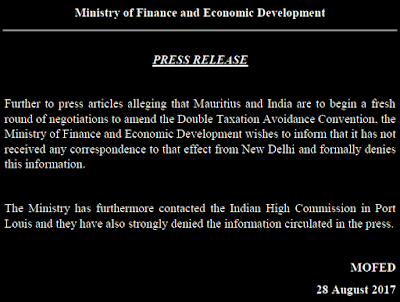
Mauritius: Communiqué in relation to Mauritius-India Double Taxation Avoidance Convention

Further to press articles alleging that Mauritius and India are to begin a fresh round of negotiations to amend the Double Taxation Avoidance Convention, the Ministry of Finance and Economic Development wishes to inform that it has not received any correspondence to that effect from New Delhi and formally denies this information. 

The Ministry has furthermore contacted the Indian High Commission in Port Louis and they have also strongly denied the information circulated in the press.


25 August 2017

Japan’s first resident Ambassador to Mauritius calls on the Prime Minister

The first Ambassador of Japan with residence in Mauritius, Mr Yoshiharu Kato, paid a courtesy call on the Prime Minister, Minister of Home Affairs, External Communications and National Development Unit, Minister of Finance and Economic Development, Mr Pravind Kumar Jugnauth, yesterday afternoon at the Treasury Building in Port Louis.

Discussions between the Prime Minister and the Ambassador centred around the strengthening of the good relations between Mauritius and Japan. The need to enhance collaboration in various sectors was also highlighted. Mr Kato recalled that the first Japanese Embassy in Mauritius opened this year, and stated that he was honoured, as the first Resident Ambassador, to have been granted an audience with the Prime Minister.

Earlier, the Ambassador presented his credentials to the President of the Republic of Mauritius, Dr. Ameenah Gurib-Fakim.

The newly appointed Ambassador joined the Japanese Ministry of Foreign Affairs in 1980. He served in various positions including Senior Deputy Director and Senior Regional Coordinator at the Second Southeast Asia Division of the Southeast and Southwest Asian Affairs Department in the Asian and Oceanian Affairs Bureau. Prior to his posting to Mauritius, Mr Kato was Consul-General of Japan in Surabaya in Indonesia.

Japanese – Mauritian Relations

Diplomatic relations between Mauritius and Japan were established in 1969. Through the Japan International Cooperation Agency (JICA), the Land of the rising sun has been providing technical assistance to Mauritius in several areas, namely disaster risk management, coastal protection and rehabilitation programme, and landslide management.

In July 2017, the State Minister for Land, Infrastructure, Transport and Tourism of Japan, Mr. Shinsuke Suematsu, was on official visit to Mauritius, accompanied by a delegation of representatives of 15 Japanese companies. A Memorandum of Cooperation to promote collaboration in the field of public infrastructure, transport and quality infrastructure investment was then signed with the Ministry of Public Infrastructure and Land Transport. Representatives of the Japanese companies also participated in business meet and networking session organised by the Board of Investment.

24 August 2017

Mauritius rated as an OECD Compliant Jurisdiction

Mauritius has been acclaimed for its continued commitment to implement the international standards of transparency and exchange of information for tax purposes. The country was rated as an Organisation for Economic Cooperation and Development (OECD) Compliant jurisdiction on 21 August 2017 by the Global Forum on Transparency and Exchange of Information for Tax Purposes.

The Global Forum conducted an enhanced peer review process aimed at assessing compliance with international standards for the exchange of information on request between tax authorities. After a thorough process during which the Global Forum assessed the legal and regulatory framework for information exchange (Phase 1), as well as, the actual practices and procedures (Phase 2), Mauritius has been classified as compliant with international standards and norms regarding transparency and exchange of information for tax purposes.

The Forum reviewed exchange of information practices through combined peer review reports in ten jurisdictions. Three jurisdictions namely Mauritius, Ireland and Norway received an overall rating of “Compliant” while six others that is Australia, Bermuda, Canada, Cayman Islands, Germany and Qatar were rated “Largely Compliant.” Jamaica was rated “Partially Compliant,” leading the Global Forum to launch a supplementary report on follow-up measures to ensure a higher level of compliance.

According to the survey, Mauritius has over the years continuously upgraded its legal and regulatory framework and ensured the practical implementation of its framework in view of becoming an OECD Compliant jurisdiction. Rated as a Largely Compliant jurisdiction in 2014, Mauritius has implemented a number of measures leading to its upgrade to “Compliant” status.

It further highlighted that Mauritius appears amongst the only 3 jurisdictions (Ireland, Mauritius, Norway) being upgraded after a second round of reviews by the Global Forum in August 2017 and the country upholds its exchange of information practices in line with the best international norms and practices.

The Financial Services Commission, as the integrated regulator for the non-bank financial services sector, is fully committed to abide by international norms and standards to ensure the sound repute and credibility of the Mauritius International Financial Centre.

Global Forum

Global Forum members are working together to monitor and review implementation of the international standard for the automatic exchange of financial account information, under the Common Reporting Standard  which will start in September 2017. The monitoring and review process aimed at ensuring the effective and timely delivery of commitments made, the confidentiality of information exchanged and to identify areas where support is needed.  

The Forum is assisting developing country members to ensure that they can also receive the benefits of the ongoing global move to automatic exchange of financial account information.

22 August 2017

Bloomberg: Could Puerto Rico Be the Next Hot Tax Haven?

A loophole may make it a good place for foreigners to keep cash.

Bloomberg

FSC Mauritius issues Communiqué in relation to the upgrade of Mauritius to an OECD Compliant Jurisdiction

The Global Forum on Transparency and Exchange of Information for Tax Purposes (Global Forum) conducted an enhanced peer review process aimed at assessing compliance with international standards for the exchange of information on request between tax authorities.

After a thorough process during which the Global Forum assessed the legal and regulatory framework for information exchange (Phase 1), as well as, the actual practices and procedures (Phase 2), Mauritius has been rated as an OECD Compliant jurisdiction on 21 August 2017.

Over the years, Mauritius has continuously upgraded its legal and regulatory framework and ensured the practical implementation of its framework in view of becoming an OECD Compliant jurisdiction.

Rated as a Largely Compliant jurisdiction in 2014, Mauritius has implemented a number of measures leading to its upgrade to “Compliant” status. Mauritius appears amongst the only 3 jurisdictions (Ireland, Mauritius, Norway) being upgraded after a second round of reviews by the Global Forum in August 2017. Mauritius upholds its exchange of information practices in line with the best international norms and practices.

The Financial Services Commission, as the integrated regulator for the non-bank financial services sector, is fully committed to abide by international norms and standards to ensure the sound repute and credibility of the Mauritius International Financial Centre.


21 August 2017

Global Forum releases second round of compliance ratings on tax transparency for 10 jurisdictions

The Global Forum on Transparency and Exchange of Information for Tax Purposes (the Global Forum) published today the first 10 outcomes of a new and enhanced peer review process aimed at assessing compliance with international standards for the exchange of information on request between tax authorities. 

The new round of peer reviews – launched in mid-2016 – follows a six-year process during which the Global Forum assessed the legal and regulatory framework for information exchange (Phase 1) as well as the actual practices and procedures (Phase 2) in 119 jurisdictions worldwide.

The Global Forum’s new peer review process combines the Phase 1 and Phase 2 elements into a single undertaking, with new focus on an assessment of the availability of and access by tax authorities to beneficial ownership information of all legal entities and arrangements, in line with the Financial Action Task Force international standard.  

The Global Forum reviewed exchange of information practices through combined peer review reports in ten jurisdictions Three jurisdictions – Ireland, Mauritius and Norway –  received an overall rating of “Compliant.” Six others – Australia, Bermuda, Canada, Cayman Islands, Germany and Qatar were rated “Largely Compliant.” Jamaica was rated “Partially Compliant,” leading the Global Forum to launch a supplementary report on follow-up measures to ensure a higher level of compliance.

Global Forum members are working together to monitor and review implementation of the international standard for the automatic exchange of financial account information, under the Common Reporting Standard (CRS), which will start in September 2017. The monitoring and review process is intended to ensure the effective and timely delivery of commitments made, the confidentiality of information exchanged and to identify areas where support is needed.  

The Global Forum is assisting developing country members to ensure that they can also receive the benefits of the ongoing global move to automatic exchange of financial account information. 

From Soviets to Oligarchs: Inequality and Property in Russia, 1905-2016

This paper combines national accounts, survey, wealth and fiscal data (including recently released tax data on high-income taxpayers) in order to provide consistent series on the accumulation and distribution of income and wealth in Russia from the Soviet period until the present day. We find that official survey-based measures vastly under-estimate the rise of inequality since 1990. According to our benchmark estimates, top income shares are now similar to (or higher than) the levels observed in the United States. We also find that inequality has increased substantially more in Russia than in China and other ex-communist countries in Eastern Europe. We relate this finding to the specific transition strategy followed in Russia. According to our benchmark estimates, the wealth held offshore by rich Russians is about three times larger than official net foreign reserves, and is comparable in magnitude to total household financial assets held in Russia.

14 August 2017

IMF Staff Completes 2017 Article IV Mission to Mauritius

  • Real GDP growth in 2017 is projected at 3.9 percent on the back of dynamism in the construction sector.
  • The authorities seek to graduate Mauritius to a high-income economy within the next ten years on the basis of an ambitious public investment program and improvements to the business climate.
  • Attaining the next level of economic development will require Mauritius to use strong and independent institutions to overcome the variety of policy challenges outlined above.

An International Monetary Fund (IMF) mission led by Amadou Sy visited Port Louis and Ebène during July 31–August 15, 2017 to conduct the discussions for the 2017 Article IV consultation with Mauritius.

At the conclusion of the visit, Mr. Sy issued the following statement today in Port Louis:

The Mauritian economy continues to be robust and staff project economic activity for 2017 to remain in line with recent trends. However, Mauritius is facing a challenging environment and vulnerabilities are rising. Options to improve resilience include: (a) rebuilding the credibility of the fiscal anchor and creating fiscal space for infrastructure and human capital investment; (b) tackling inflationary pressures by tightening monetary policy, while modernizing the monetary policy framework to strengthen the policy response to shocks; (c) addressing financial stability risks, and (d) improving competitiveness to support growth.” 

The authorities seek to graduate Mauritius to a high-income economy within the next ten years on the basis of an ambitious public investment program and improvements to the business climate. Attaining the next level of economic development will require Mauritius to use strong and independent institutions to overcome the variety of policy challenges outlined above. Early signs are promising, with both the pending formation of the National Economic Development Board, and the drafting of the Financial Sector Blueprint, important welcome steps towards harmonizing the policy direction and implementation across sectors. Considering Mauritius’ track record of reinventing its economic model, there are grounds for optimism that the country will successfully manage the reform process.” 

Real GDP growth in 2017 is projected at 3.9 percent on the back of dynamism in the construction sector. Tourism and financial intermediation activities are expected to provide support, though at a slower pace than 2016. Domestic demand will continue to be supported by recovering business and consumer confidence, and increased public investment. However, falling sugar production and subdued exports would weigh down on agriculture and manufacturing activity. The capital and financial account has proven resilient in the face of the revised Double Taxation Avoidance Agreement (DTAA) with India, mainly owing to the grandfathering clause.

The fiscal stance remains expansionary. The overall budget deficit stood at 3.4 percent of GDP in FY2016/17, down from 3.6 percent of GDP in FY2015/16, mostly reflecting the underexecution of the capital budget and increased tax revenue mobilization. The primary balance (excluding grants) and the overall borrowing requirement deteriorated somewhat.  Total public debt remained constant at 65 percent of GDP. Staff recommends supplementing the planned fiscal consolidation with additional revenue mobilization efforts to strengthen the credibility of the fiscal anchor. Additional elements of a growth-friendly fiscal consolidation include improvements in public investment and debt management.

Inflation has picked up on the back of supply shocks, but there are signs of further building inflationary pressures. Headline inflation outcomes in the first half of the year surprised on the upside, and more than doubled to 5.3 percent year-on-year in July from 2.3 percent at the end of 2016, mostly driven by higher food and fuel prices, the increase in excises on tobacco and alcohol products. Headline inflation is expected to remain above 5 percent during the second half of 2017 onwards, mostly on account of second round effects.

Monetary policy is accommodative. The Key Repo Rate (KRR) has been kept constant at 4 percent in the last year. Nominal interest rates are at historically low levels, and real market interest rates are negative. The mission recommends tackling inflationary pressures by tightening monetary policy, while modernizing the monetary policy framework to strengthen policy response to shocks” 

The Global Business Sector is under pressure from international anti-tax avoidance initiatives. The authorities are undertaking efforts to address the concerns raised by the OECD and the EU in these matters. Prioritizing the adoption of the Blueprint for the Financial Services Sector, can help the GBC sector transition from a system based largely on tax incentives to one that provides higher value added services.” 

The overall current account deficit narrowed at the end of 2016 to 4.4 percent of GDP, reflecting strong tourism receipts and net income balances. Yet it is expected to widen over the medium-term, due to growing domestic demand, the high import component of the government’s investment program, and planned aircraft purchases. The team estimates that Mauritius’ external position at the end of 2016 was weaker than implied by medium-term fundamentals and desirable policies.  Staff recommends allowing more flexibility of the exchange rate to help address the emerging imbalances, and maintaining reserve coverage at least at 100 percent of the adequacy metric to safeguard external stability.

Mauritius has made great strides over the last decade to top the competitiveness rankings in Sub-Saharan Africa (SSA), but still lags emerging market peers as lackluster productivity and rapid real wage growth in recent years have reduced cost competitiveness.

The recently-adopted Business Facilitation Act is a welcome step to improve Mauritius’ business environment. Broader structural reforms in areas such as the labor market including the promotion of youth and female labor participation in the labor force, higher education and innovation policies will be key drivers of Mauritius’ economic transformation going forward.” 

The mission met with Prime Minister and Minister of Finance and Economic Development, Pravind Jugnauth, Minister of Financial Services, Good Governance and Institutional Reforms, Dharmendar Sesungkur, Governor of the Bank of Mauritius Rameswurlall Basant Roi, other senior government officials, as well as the private sector, academia, and civil society. The mission would like to thank the Mauritian authorities for their excellent cooperation, and the very productive discussions. The IMF stands ready to support the authorities’ reform efforts, including through the provision of technical assistance, and looks forward to a continued and fruitful policy dialogue in the period ahead.

Foodies Sacrifice Cost and Convenience for Quality

You might describe yourself as a “foodie” if you post photos of your avocado toast on social media or gift homemade jam with fruit from your garden. But being a “foodie” means much more than this.

According to the International Food Information Council (IFIC) Foundation’s 2017 Food and Health Survey, foodies are more confident in their nutrition know-how, will sacrifice cost and convenience to get foods that align with their values, and even define “healthy” differently than other types of consumers.

An analysis of purchase drivers from 2017 Food & Health Survey findings reveals six distinct groups of consumers, including foodies.  These profiles help us understand how different consumers think about and shop for food beyond traditional demographics, like age, income or gender. Other groups identified include pleasure shoppers, diligent searchers, product selectors, unbiased buyers and indifferent consumers.

You Might Be a Foodie If…

According to the Food and Health Survey, a foodie is someone who sacrifices convenience and cost in search of a quality product, particularly one that is tasty, healthy, and made in a way that aligns with their personal beliefs.

Foodies also have a different definition of healthy food compared to other Americans. While the other five profile groupings consider a healthy food to be “part of an important food group,” foodies are the only group to include “minimally processed” in their top three attributes of a healthy food. Foodies also chose “free from artificial ingredients, additives” and “high in healthy components or nutrients,” rounding out their definition of healthy.

Foodies are also more confident in their nutrition know-how. While only 44 percent of the general population could name a food or nutrient associated with their most desired health benefit, 60 percent of foodies were able to do so. In addition, when confronted with conflicting nutrition information, this group was among the least likely to doubt their food decisions.

Other groups prioritize the cost and convenience of food while foodies are more likely to sacrifice these purchase drivers for quality. They are also not as concerned with sustainability or packaging. However, for foodies, taste still reigns supreme when deciding to purchase a food or beverage.

According to the survey, foodies are predominately female (63% female vs. 37% male), have higher incomes (52% make more than $75,000 a year) and a median age of 58. They are also less likely to have kids under 18. This might partially explain why foodies aren’t as concerned about convenience or the cost of food.

As in previous years, the Food and Health Survey has shown us what drives consumers in their food purchasing decisions, but this is the first year we took a look at how foodies distinguish themselves from consumers generally,” said Alexandra Lewin-Zwerdling, Ph.D., vice president of research and partnerships at the IFIC Foundation. “Our hope is that by better understanding the attitudes, perceptions, and habits behind consumer behavior, we can work with partners to enhance and develop effective nutrition education strategies.

10 August 2017

Mémento: L'île Maurice se modernise

Le gouvernement mauricien se donne-t-il les moyens de réaliser ses ambitions? 

 Numéro Spécial Ile Maurice

04 August 2017

MCB Review of charges as from 4th September 2017 - Global Business

TransactionCurrent PricingReviewed Pricing
Overseas Banks’ charges relative to International Transfers (SWIFT) in USD and EURO respectivelyUSD 12.50USD 25
EUR 10 / EUR 15< EUR 50,000EUR 22
> EUR 50,000EUR 40
Outward Telegraphic Transfer through Internet Banking0.125%, minimum USD 25 / maximum USD 650.125%, minimum USD 30 / maximum USD 75
Outward Telegraphic Transfer through other channels0.15%, minimum USD 35 / maximum USD 800.15%, minimum USD 40 / maximum USD 85
Audit Confirmation (by email / post)< 1 year: USD 25 / > 1 year: USD 40< 1 year: USD 50 / > 1 year: USD 75
SWIFT transfer after cut-off time (Late payment fee)Not applicableUSD 100
Bank ReferenceUSD 25USD 50

03 August 2017

New report by TheCityUK reveals the considerable contribution the UK-based legal and accountancy sector makes to the UK’s public finances

In 2015/16 the UK-based legal and accountancy sector generated an estimated £15.5bn in tax – comprised of taxes borne (£6.4bn) and taxes collected (£9.1bn) – representing 2.5% of all UK tax receipts. This is roughly equivalent to total UK spending on police services. The report underlines Britain’s leading position in Europe as a legal and accounting hub.

According to the report, ‘Total Tax Contribution Study for UK legal and accounting activities’, which was produced by PwC, the sector collectively generated employment of 693,000 across the UK – nearly one quarter (23%) of EU employees in the sector are in the UK. Britain’s premier position as a legal and accounting services employer is trailed by Germany at 21% of the EU’s total sector jobs, then France (10%), Spain (8%) and Italy (7%).

Added together with the significant total tax contribution for the financial services sector, reported as £71.4bn in 2015/16, the estimated total tax contribution for UK-based financial, legal and accountancy services is £87bn.

Miles Celic, Chief Executive, TheCityUK, said,

The legal and accounting sector make a considerable contribution to the UK economy in their own right, and are an essential part of the world-leading financial and professional services ecosystem.

The UK is the leading global hub for legal and accounting expertise and it is vital that we not only preserve that, but we continue to grow it. This expertise isn’t just located in London. Right across the UK, centres of excellence, including Manchester, Bristol and Edinburgh, are adding value to the UK economy. These are also the areas we expect to see the most growth in the coming years as we move through Brexit and beyond.

In 2016, there were nearly 60,500 legal and accounting businesses in the UK with small to medium sized enterprises with fewer than 99 employees making up 99% of all firms.

The report from TheCityUK and PwC is the first such study to cover legal and accounting activities and highlights the importance of these activities to the UK economy.

Total Tax Contribution Study for UK legal and accounting activities

31 July 2017

FSC Mauritius - Publication of FSC ‘Policy Research Series’ - No. 1 (FSC PRG Series No. 1 – July 2017)

The Financial Services Commission, Mauritius (“FSC”) is pleased to announce the publication of the first project for its Policy Research series under the Policy Research Group (PRG) Phase I (2015/16) initiative.

This research entitled “A Feasibility Study of Social Investment in Mauritius” underlines the significance which the FSC devotes to research and development in spearheading its mission.

The authors have assessed the potential for the emergence of social impact investment in Mauritius. The main findings of the study have brought forth valuable insights which could be useful for gearing social impact investment in Mauritius.

A mixed methodology comprising a survey questionnaire and focus group discussion with representatives of Ministries, public sector agencies, fund managers, foundations and commercial banks in Mauritius has been adopted. The findings highlight the need for a social investment market in Mauritius and the importance of social investment as an innovative way to finance projects which have societal and/or environmental impact.

A SWOT analysis conducted has led to the formulation of a number of recommendations such as the setting up of an Interagency Task Force, promotion of social investment culture, building a strong intermediation, consolidating social investment ecosystem on existing framework and paving the way for social entrepreneurship to embrace social investment in Mauritius.

The FSC wishes to thank members of the PRG Selection Committee and the international editorial and advisory council of the FSC Policy Research Series who have worked together with an internally dedicated team to ensure the quality assurance of the research. The report can be downloaded on the FSC website.

Financial Services Commission, Mauritius
31 July 2017


27 July 2017

Mauritius - Audit Committee Forum Paper 5: Guidelines for the Audit Committee’s approach to Information Technology Risk

The Position Papers, produced periodically by the Audit Committee Forum, aim to provide Board directors and specifically Audit Committee members with basic best practice guidance notes to assist in the running of an effective Audit Committee.


26 July 2017

Disputes over the British Indian Ocean Territory: July 2017 update

This briefing describes the main developments since mid-2013 in long-running disputes over the British Indian Ocean Territory (BIOT). In November 2016 the previous UK Government decided not to allow Chagossian resettlement. The status of the Marine Protected Area is contested. The UK and Mauritius have been holding talks on sovereignty. In June 2017, the UN General Assembly voted to ask the International Court of Justice to give an advisory opinion on the issue. The US military base on Diego Garcia is set to continue until 2036. Meanwhile, there continues to be litigation in the English courts.

Background

Between 1968 and 1973 the British Government cleared the entire Chagos Archipelago of its inhabitants, in anticipation of a US military base on the biggest island, Diego Garcia. The Archipelago was made a colony, the British Indian Ocean Territory (BIOT). It subsequently became a British overseas territory.

Two main disputes have arisen from these events. One has been between the Chagos Islanders and the British Government over the legality of their removal and whether they have a right to return. The other has been between the UK and Mauritius about sovereignty over the BIOT. In 1965 the UK undertook that it will cede sovereignty to Mauritius once the BIOT is no longer required for defence purposes.

A May 2013 Library briefing surveyed the origins and subsequent evolution since 1965 of these disputes, including past and ongoing legal cases brought before British, European and international courts. The briefing went on to explore potential ways forward for resolving these disputes by the time of the UK general election in May 2015. This update summarises the main developments over the intervening four years.

November 2016: the previous UK Government decides against resettlement

A fresh resettlement feasibility study has been carried out. It set out three resettlement options: large-scale resettlement; medium-scale resettlement; and pilot, small-scale resettlement. However, in November 2016 the previous Government announced that it had decided not to allow resettlement. The decision provoked condemnation from Mauritius and supporters of the Chagossian cause in the UK, and raised the prospect of further legal action. Since then, there has been debate about the best use of – and motives behind – a £40 million support package for Chagossians and renewed calls for the restoration of the right of abode as a prelude to a change of policy on resettlement.

The Marine Protected Area in limbo?

A Marine Protected Area (MPA) introduced by the British Government around the Chagos Archipelago (apart from Diego Garcia, where there is a US military base) in 2010 was ruled unlawful in 2015 by a Tribunal under the UN Convention on the Law of the Sea. The UK has insisted that the MPA is still in place. The Tribunal was much more equivocal on sovereignty than the Mauritian Government, which brought the case, will have hoped. It declined jurisdiction on the issue but found that the UK’s 1965 undertaking to cede sovereignty to Mauritius when the BIOT is no longer required for defence purposes is binding under international law.

Movement on sovereignty?

In 2015 a Marine Protected Area (MPA) introduced by the British Government around the Chagos Archipelago (apart from Diego Garcia, where there is a US military base) was ruled by a Tribunal under the UN Convention on the Law of the Sea to have been established without proper regard to the rights of Mauritius. Some legal commentators have taken this as tantamount to saying that the MPA is unlawful. The UK disagrees with this interpretation. The Tribunal was more equivocal on sovereignty than the Mauritian Government, which brought the case, will have hoped. It declined jurisdiction on the issue but found that the UK’s 1965 undertaking to cede sovereignty to Mauritius when the BIOT is no longer required for defence purposes is binding under international law.

Movement on sovereignty?

In July 2016 Mauritius said that it would seek a referral by the UN General Assembly to the International Court of Justice later in the year in order to obtain an advisory opinion on sovereignty. Mauritius ultimately held back from seeking a referral and there have been talks between the two governments. But Mauritius said that it would seek a referral in June 2017 if insufficient progress was made in the talks by then. On 22 June 2017 the General Assembly voted 94-15 to refer the issue.

The US military base is extended until 2036

A decision on whether to extend the life of the US military base on Diego Garcia for a further 20 years had to be made by the end of 2016. The decision to do so was announced in November 2016.

Litigation in the English courts

In June 2015 the Supreme Court heard an application for the 2008 verdict of the House of Lords – which ruled that the use in 2004 of Orders in Council to prevent the Chagossians from returning had been lawful – to be set aside. In June 2016 the Supreme Court ruled against the application by a majority of 3 to 2. However, the decision of the previous UK Government against allowing resettlement has led to an application for judicial review of the original ban. Supporters of the Chagossians hope that it will be heard during 2017 but it may not happen until 2018.

The Supreme Court heard an appeal on behalf of Chagossians against the MPA on 28-29 June 2017.


24 July 2017

Uncovering Offshore Financial Centers: Conduits and Sinks in the Global Corporate Ownership Network

Multinational corporations use highly complex structures of parents and subsidiaries to organize their operations and ownership. Offshore Financial Centers (OFCs) facilitate these structures through low taxation and lenient regulation, but are increasingly under scrutiny, for instance for enabling tax avoidance. Therefore, the identification of OFC jurisdictions has become a politicized and contested issue. We introduce a novel data-driven approach for identifying OFCs based on the global corporate ownership network, in which over 98 million firms (nodes) are connected through 71 million ownership relations. This granular firm-level network data uniquely allows identifying both sink-OFCs and conduit-OFCs. Sink-OFCs attract and retain foreign capital while conduit-OFCs are attractive intermediate destinations in the routing of international investments and enable the transfer of capital without taxation. We identify 24 sink-OFCs. In addition, a small set of five countries – the Netherlands, the United Kingdom, Ireland, Singapore and Switzerland – canalize the majority of corporate offshore investment as conduit-OFCs. Each conduit jurisdiction is specialized in a geographical area and there is significant specialization based on industrial sectors. Against the idea of OFCs as exotic small islands that cannot be regulated, we show that many sink and conduit-OFCs are highly developed countries.

21 July 2017

Steven Obeegadoo: 'Fini la culture d’impunité! La démocratie avance à grands pas'

Il est facile d’identifier les dysfonctionnements des partis politiques à Maurice ou ailleurs. Mais les citoyens ne se bousculent plus pour renouveler les structures politiques ou participer aux débats en vue de développer de nouvelles pratiques dans le milieu politique. Steven Obeegadoo, engagé politique de longue date, partage ses initiatives pour favoriser le renouvellement des idées et livre ses impressions sur l’importance de l’intelligence collective au 21e siècle.

19 July 2017

'Occupation: Fraudster. Address: Street of 40 Thieves’ — how Italians mocked UK company rules

When alleged mafia money launderer Antonio Righi wanted to do shady deals out of sight, it was to London, not just Naples, that he turned to hide his trail, according to Italian prosecutors.

Evening Standard

14 July 2017

Rajiv Servansingh: A “failed state” not yet but dangerously close

As we suggest in the title to this paper, it would perhaps be a bit of an exaggeration to state that Mauritius is now a “failed state” as has been intimated by some analysts. However it is our serious contention here that, in the absence of a serious change in the prevailing trajectory, it is to be feared that we would sooner rather than later be joining the infamous category.