20 September 2017

Oracle Continues Africa Expansion with New Mauritius Office

Oracle announced today the opening of its new office in Mauritius to advance the rapid growth of Oracle's Cloud computing business and provide seamless support to Oracle customers and partners in the island nation and the African continent.

Key dignitaries including Mauritius' Honourable Minister of Technology, Communication and Innovation Yogida Sawmynaden; Cherian Varghese, Vice President – Technology, Africa, Oracle and Dr. Avinash Ramtohul, Country Leader – Mauritius, Oracle attended a launch event at the new office to mark the milestone.

"Mauritius is a strategic high growth market for Oracle and we have continuously invested in enhancing our local capabilities and service offerings", said Cherian Varghese. "We are excited to expand our presence with the new office for which we will soon start hiring digitally savvy candidates with a strong sense of personal drive and the ability to successfully sell some of the world's most exciting cloud technologies."

Oracle has been present in Mauritius for more than two decades and the company has been instrumental in driving digital transformation for key entities from both the public and private sector.

"Mauritius has traditionally been an early adopter of enterprise technology and hence the country ranks highest amongst African nations on the ICT Development Index (IDI)", said Yogida Sawmynaden. "Our vision is to further develop Mauritius' ICT sector as a key economic pillar. It is through the continued investment, from companies such as Oracle, that this vision will be realised; not only through their ongoing support to drive digital transformation in Mauritius but also with their capacity building initiatives, aiding the development of a skilled workforce."

Expanding presence across Africa to support a fast growing customer and partner base is a key priority for Oracle. Oracle now operates 13 dedicated offices across Africa; these include two each in Nigeria, Egypt and South Africa and single offices in Algeria, Kenya, Ghana, Ivory Coast, Senegal, Morocco and Mauritius.

Cloud computing led digital transformation is fast gathering pace in Mauritius. As per a recent IDC CIO survey, 45% of organizations in Mauritius are planning on implementing private cloud service hosted and managed by a third party datacentre within the next 24 months, with over 20% confirming that they have already implemented private cloud solutions. There is a clear indication that the region is ready to embrace business digitisation, as the need for Enterprise Resource Planning (45%), Platform as a Service (30%) and Storage as a Service (38%) rank high in the list of public cloud services companies are planning to adopt over the next 24 months.

18 September 2017

A Hacker’s Guide to Destroying the Global Economy

A massive cyberattack on our financial system is coming. This is how it happens. By Ben Sullivan.

15 September 2017

Nespresso Explorations 2 - One Of A Kind Coffee Collection

Welcome to the second edition in our one of a kind coffee collection, EXPLORATIONS.


COLOMBIA AGUADAS


The particular microclimate high up in the Aguadas region of Colombia, meant one pocket of farmers made their coffee in an unusual way, resulting in an extraordinary cup. Welcome to the story of Colombia Aguadas.


A Matter Of Timing


Sometimes, things happen when you least expect, and the creation of this coffee was one of those moments. Always on the lookout for something special, it was after a routine coffee cupping that a new taste note unlike any other we’d previously seen in the region leapt from the table. So, excited by this special profile potential, we set out to discover just how it had been created.


Our agronomists worked with the Aguadas cooperative to investigate which particular practices had created the extraordinary cup quality. They discovered that tucked high up in the Aguadas mountains, the cold nights meant a small group of farmers had to ferment their coffee for a little longer than usual.


This seemingly simple alteration brought about the most incredible taste potential. As well as longer fermentation, these farmers were highly selective in only picking the ripest cherries and then solely sun drying their beans in the Colombian sun.

Unwavering Dedication


Trusting in the expertise of the agronomists, these 61 coffee farmers agreed to fine-tune their practices in order to consistently create the exact quality we were after, bringing you this special cup.


It’s testament to the farmers’ skill, commitment to their crop, and a trusting relationship with our agronomists, that they could perfect what was found on the cupping table. Allowing us to bring you a Colombian coffee different to any we have brought you before.


A New Taste Unearthed


This discovery has shifted our perception of what an Aguadas coffee can be.


The farmers’ drive and devotion to what they do allows you to meet Colombia Aguadas

With an average medium roasting, we’ve developed a complex profile– the gentle acidity dances with incredibly sweet notes, bringing to mind dulcet candied fruits.


Life In A Cooperative


Being part of a coffee cooperative is about more than just business. The strong community bond sees farmers helping and supporting each other and means the farming families have greater access to education programs, advanced agronomy training and improved farm facilities.


So, within the cooperative, they not only get to produce even better quality coffee, but their love for what they do is able to grow too. And you can taste it in every cup.


The Rewards Of Fairtrade


When farmers work with Nespresso, we ensure they get a good deal for their coffee. That is why one of the keys of the growth of the Aguadas coffee cooperative has been to become Fairtrade certified as well as to sell their coffee through the Nespresso AAA Sustainable Quality™ Program.


Many of the region’s villages now benefit from services financed with the Fairtrade Premium in the Aguadas cooperative. The Fairtrade Premium comes on top of the coffee price; it is received directly by the cooperative and spent according to the community’s needs.

Since 2005, the region has also participated in the Nespresso AAA Sustainable Quality™ Program. This program is our unique coffee sourcing program. It ensures we can offer the highest quality coffees to our consumers while delivering positive impact to farmers, their communities and the surrounding landscapes. We have also worked to provide retirement savings for the cooperative farmers – a program designed by the Colombian government and implemented as a Fairtrade pilot by Nespresso.

The Fruit Connection


Colombia Aguadas has a special aromatic connection to other Grand Crus in our collection such as Rosabaya de Colombia, Cosi and Livanto, however each coffee has its own specificities.


Rosabaya De Colombia


Rosabaya de Colombia is another coffee with prominent acidity and fruity notes. While bringing you the same rich roast and body, Rosabaya de Colombia bears winey notes more like red fruits, while the Colombia Aguadas dulcet fruit has a pleasing sweetness reminiscent of candied apples and red berries.


Cosi


Cosi is crafted from a blend of both Kenyan and South American Arabicas and brings you a more subtle sweetness. The Arabicas in Cosi also bring characteristic cereal and lightly toasted notes to the coffee rather than the candied sweetness of Colombia Aguadas.


Livanto


Livanto shares the same balanced profile as Colombia Aguadas. A medium roasting similar to Colombia Aguadas accentuates malted notes, whilst fruity notes evolve to create a complex and delicate, caramelised bouquet.


Taken With Milk


We recommend drinking Colombia Aguadas black to perceive the aromatic subtleties of the origin. If drunk with milk, we suggest trying it as a Latte Macchiato. 
Milk blends perfectly with this Espresso resulting in an elegant and creamy beverage with sweet caramelised and fruity notes.

ETHIOPIA YIRGACHEFFE


After years of patient searching and sampling, this coffee jumped off the cupping table and brought back to life the elusive and historical notes thought by many to have slipped away forever. Welcome to the story of Ethiopia Yirgacheffe.

Legend Of The Yirgacheffe Coffee

One particular south central region of Ethiopia is world famous for its distinctive coffee flavour. For as long as coffee has existed, the district of Yirgacheffe has been home to the floral notes of Jasmine blossom and Bergamot citrus. Like the fine feathers in a ladies hat, these delicate notes have been cherished by both locals and coffee lovers alike.

However, after alterations in trade routes and how coffee was sold in communal lots, these particular flavours became diluted and much more difficult to find. But, not happy with bringing to you anything less than what we knew a true Yirgacheffe coffee could be, we kept on looking for what we were sure was still out there.

Hunting For Elusive Notes

You know what it’s like when you set your mind to something. We wouldn’t accept anything short of what we knew was possible. Sure, it took some time, but we never gave up hope. Constantly waiting and looking, we carefully watched the crops in the region for these treasured notes to appear again.

With nothing hitting the mark, we passed on lot after lot and continued our search. Until one day. Those classic flavours leapt once again from the cupping table. When it was time to act, we were ready.

A Cherished Taste Returns

The aromas found on the cupping table that day were delicately perfumed and sprinkled with the magic of white floral notes, transporting us to the blossom-scented home of the origin of coffee. Sounds worth waiting for, don’t you think?

Having taken so long to find again, we handled these precious notes like exquisite china – gently crafting Ethiopia Yirgacheffe with a light roasted profile resulting in a fine velvety texture. Carefully bringing everything together for a coffee with all the finesse of a true, authentic Yirgacheffe.

A Land Of Coffee Lovers

Welcome to the place where coffee is part of the family. It’s been part of Ethiopia's indigenous cultural tradition for more than 10 generations. Considered the birthplace of coffee, it still grows wild high up in the mountain forests. Unlike many coffee growing countries, Ethiopians drink half as much coffee as they export.

A daily ritual in most homes across the country is the ornate coffee ceremony where they roast beans in an open pan over a fire and come together to talk and drink.

The Rewards Of Fairtrade

Sustainability is right at the heart of what we do and when it comes to bringing you a responsible cup, Nespresso is always partnering up to ensure the highest positive impact for farming communities. That’s why we work with partners like Fairtrade International.

The Yirgacheffe Cooperative unites 22 farms, all Fairtrade. As well as being focused on producing the best coffee crops, the members of the cooperative have proudly invested Fairtrade money into both education and community infrastructure. As most farms are smallholders, this not only strengthens the community, it is also a vital way to help secure the smooth delivery of their coffee from the farms to your cup.

The Floral Connection

Our second coffee from the country, Bukeela ka Ethiopia is also a Pure Origin but this Grand Cru comes from Sidamo and other Western regions of Ethiopia.

Bukeela ka Ethiopia

Bukeela ka Ethiopia is lighter in body and less intense than Ethiopia Yirgacheffe but also has those delicate floral notes the country’s coffee is known and loved for.

Taken With Milk

We recommend drinking Ethiopia Yirgacheffe black to perceive the aromatic subtleties of the origin. If drunk with milk, we suggest trying it as a Latte Macchiato. This coffee will become even more aromatic with surprising floral notes reminiscent of a violet candy. The addition of milk brings sweetness and a biscuit flavour to this tasteful Espresso.

14 September 2017

Vistra to Acquire Corporate Services Business from Deutsche Bank

Vistra, a leading global corporate service provider, announced today that it has entered into a definitive agreement to acquire the Corporate Services business of Deutsche Bank’s Global Transaction Banking division. 'Corporate Services' provides management and administration of SPVs and asset holding companies to banks, non-bank financial institutions and corporates. The business specialises in the administration of structures for:
  • Structured Finance transactions (CLOs, CDOs, Securitizations, Mortgage-Backed Securities);
  • Aircraft Leasing;
  • Commercial Real Estate holding; and
  • Investment Funds (mainly private equity and real estate).  
Operating in the United Kingdom, Ireland, Luxembourg, the Netherlands, Jersey, Mauritius, Cayman Islands and the US, the business employs 139 staff globally. The transaction is subject to regulatory approvals.

Expected to close in the first half of 2018, the transaction will assist Vistra to continue on its progressive growth trajectory. The acquisition strengthens Vistra's international network and provides further scale and expertise for existing jurisdictions. All of Deutsche Bank's Corporate Services staff will be given the opportunity to join the combined operation to support and grow the client relationships that are at the core of this acquisition. Terms of the agreement are not being disclosed. 

Commenting on the acquisition, Onno Bouwmeister, Vistra’s Group Managing Director of Alternative Investments division stated “This acquisition marks another significant step in Vistra’s growth, broadening our presence in seven of our existing locations across Europe, the Cayman Islands and Mauritius. It gives us presence in Ireland, a key strategic jurisdiction particularly in light of the upcoming ‘Brexit’ process, and additional capability in Mauritius where the bulk of the back-office administrative activity is carried out to high quality standards. This additional expertise in the Capital Markets sector will have a significant impact on our Alternative Investments division, creating exciting opportunities for our new employees and clients alike. We look forward to working together to build on our achievements to date and take Vistra to the next level.

Jose Sicilia, Deutsche Bank's Head of Trust and Agency Services, Global Transaction Banking said “Our main goal with this transaction was to find a partner that will continue to deliver the highest quality services to our Corporate Services clients as well as a dedicated Corporate Service provider for our staff. This will enable us to sharpen our focus on our existing award-winning securities services business. We feel we have achieved our objective with Vistra.

13 September 2017

Herbert Smith Freehills research reveals Artificial Intelligence will recast the relationship dynamic between legal providers and clients

International law firm Herbert Smith Freehills has published the results of its Artificial Intelligence (AI) research anticipating its impact on the legal practice. The report, Artificial Intelligence: The client perspective, reveals that clients want their legal providers to focus on collaboration, new ways of service delivery and talent development. The introduction of AI into law firms' working practices will enable firms to meet these client demands.


Investing in AI technologies seems an obvious strategy for law firms. However, the technology is a means to an end. Clients may not contribute to law firms' AI investments but they expect their legal providers to take a lead in offering progressive services and solutions to recast the value gleaned from their relationships. Law firms need to take charge of creating the right mix of human and machine capabilities to recast future relationships that benefit both provider and client.

The research compiles the views of senior clients – including general counsels, chief operating officers and strategy directors – from 22 leading international companies from a wide range of industries, including the financial, insurance, real estate and consumer goods sectors.

The findings suggest that clients have strong views in three distinct areas:
  1. Recast the relationship dynamic: Clients believe that AI tools will lead  to greater efficiency and challenge revenue models but also – and more importantly – drive an enhanced engagement. Clients want their law firms to move beyond traditional transactional lead delivery to a new, more collaborative relationship model.
  2. Embrace new business models: Clients want to know that their legal provider is making the best decisions around innovation, combining new technologies with new ways of working, including collaborating with third parties and challenging existing processes.
  3. Reshape the talent pool: Clients expect that their legal provider can still deliver top human talent as  well as take advantage of technology.
CEO Mark Rigotti comments:

"Artificial intelligence is advancing rapidly and is changing the way law firms do business, the way we interact with clients and ultimately, the way we think. The traditional model for delivering legal services is being redefined and clients expect their law firms to deliver more value. At Herbert Smith Freehills providing legal services aligned with legal technology solutions, remains at the heart of our innovation agenda."

12 September 2017

Who Owns the Wealth in Tax Havens? Macro Evidence and Implications for Global Inequality

Drawing on newly published macroeconomic statistics, this paper estimates the amount of household wealth owned by each country in offshore tax havens. The equivalent of 10% of world GDP is held in tax havens globally, but this average masks a great deal of heterogeneity—from a few percent of GDP in Scandinavia, to about 15% in Continental Europe, and 60% in Gulf countries and some Latin American economies. We use these estimates to construct revised series of top wealth shares in ten countries, which account for close to half of world GDP. Because offshore wealth is very concentrated at the top, accounting for it increases the top 0.01% wealth share substantially in Europe, even in countries that do not use tax havens extensively. It has considerable effects in Russia, where the vast majority of wealth at the top is held offshore. These results highlight the importance of looking beyond tax and survey data to study wealth accumulation among the very rich in a globalized world.

Who Owns the Wealth in Tax Havens? Macro Evidence and Implications for Global Inequality (Annette Alstadsæter, Niels Johannesen and Gabriel Zucman), NBER working paper 23805, September 2017

11 September 2017

Despite Brexit Uncertainty London Remains On Top

There is an overall drop in confidence amongst the leading centres. Of the top 25 centres, 23 fell in the ratings and only two rose. At the lower end of the table, 20 of the 25 lowest rated centres actually rose in the GFCI ratings.

There is little change in the top five positions. London and New York remain in first and second places. Interestingly, despite the ongoing Brexit negotiations, London only fell two points, the smallest decline in the top ten centres. Hong Kong has moved just ahead of Singapore into third – only two points ahead on a scale of 1,000. Tokyo remains in fifth.

The gap between third place Hong Kong and second place New York is now only 12 points. This is the smallest gap between second and third places for over five years. New York fell by 24 points, the largest fall in the top 15 centres, presumably due to fears over US trade.

Western European financial centres are still volatile. Frankfurt, Dublin, Paris and Amsterdam all rose, but Zurich, Geneva, and Luxembourg fell in the ratings. Overall assessments for the European centres continued to fluctuate as people speculate about which centres might benefit from London leaving the EU. However, the majority of centres in the region rose with Stockholm, Copenhagen, and Vienna all showing strong rises.

The leading financial centres in the Asia/Pacific region fell in the ratings. All of the top ten centres in the region fell in the ratings with Singapore, Tokyo, and Osaka all showing marked declines. These are reverses of strong gains made in 2015-16.

All centres in North America fell in the GFCI ratings. As mentioned above, New York fell. San Francisco, Boston, Chicago, and Washington also saw large falls. The decline of Canadian centres was less severe than the falls of the USA centres.

All of the Eastern European centres rose in the ratings. Cyprus, Athens, St Petersburg, and Moscow reversed some of their recent declines.

Financial centres in the Middle East and Africa showed mixed results in GFCI 22. Dubai and Casablanca fell slightly, but other centres in the region did well. Abu Dhabi, second in the region, reduced the gap to first place Dubai to just nine points. Elsewhere in the Middle East, there were good rises for Bahrain and Riyadh.

Latin American and Caribbean centres did well. The Caribbean centres of the British Virgin Islands and the Bahamas saw strong rises. Sao Paulo and Rio de Janeiro also did well. Buenos Aires joined the main GFCI, but Santiago remains an associate centre having failed to accumulate a sufficient number of assessments to enter the main index.

European ‘island’ centres did well. The British Crown Dependencies of Jersey, Guernsey, and the Isle of Man all performed strongly and there were also strong rises for Malta, Reykjavik, and Gibraltar.

07 September 2017

Is ‘offshore’ a dirty word?

Until recently the wealthy could stash their cash offshore with impunity. Now, amid public resentment, they and their favoured havens are having to embrace transparency, says Alec Marsh

06 September 2017

Royal Grill: a delicious starlit grill on the beach at Royal Palm

Sitting at a table on one of the best beaches in the north of Mauritius and surrounded by torches underneath a starlit sky, guests at Royal Palm Beachcomber Luxury can enjoy a superb grill dinner menu prepared by Chef Michel de Mattéis every Thursday evening.

The Royal Grill has become a favourite among regular guests and first-timers alike at this legendary grand hotel. The evening has a special flavour and is a great opportunity for couples, families or groups of friends to share a pleasant moment in a chic yet informal atmosphere around a delicious meal in a truly magical setting. The menu varies depending on the season and is an invitation to enjoy some luscious and juicy grilled specialities. Homemade smoked fish, an ample choice of salads and mixed vegetables, a cold turmeric zucchini soup, a tabbouleh with fresh mint and calamari snacks with a touch of turmeric provide an appetizing introduction. These are followed by the catch of the day, freshwater Camaron shrimps, chicken satay skewers, Angus rib steaks, lamb chops and chicken ‘Kalia’, all served with white rice, a vegetable fricassee with lemon and a tasty choice of sauces and dressings.

For a sweet conclusion to this unique culinary experience, there is a selection of desserts for the true gourmands, from fruit skewers with vanilla glaze to the mango and coconut fondant and the pineapple and lime verrine with a lychee emulsion.

Epicures, young and old, will enjoy the delicate flavours as well as the warm and convivial atmosphere of the Royal Grill!

01 September 2017

Mauritius: FSC Administrative Penalties

Corporations holding a Category 1 Global Business Licence (GBC 1) are required, pursuant to Section 30 of the Financial Services Act 2007 (the FSA), to file with the Financial Services Commission (FSC) every year, audited financial statements while corporations holding a Category 2 Global Business Licence (GBC 2) are required to file financial summary with the FSC each year.

The audited financial statements /or financial summary should be submitted within six (6) months after the financial year end of the GBC 1 / or GBC 2, except where otherwise required under any other relevant Acts. Other relevant Acts are defined under the FSA and include among others, the Insurance Act 2005 and the Securities Act 2005.

Non-compliance with the deadline entails the GBC 1 / or GBC 2 to incur administrative penalties - as detailed in the Schedule accompanying the Financial Services (Administrative Penalties) Rules 2013 (‘the Rules’). Administrative penalties are calculated based on business days only. The administrative penalty imposed for each business day is USD 10 for GBC 1 and GBC 2.

30 August 2017

Nespresso BARISTA Limited Edition coffees

Pairing the finest quality coffee with smooth milk is a flavour harmony that has long transfixed professional baristas. Now, Nespresso is bringing this sensation to the home with three new limited edition coffees, two of which have been especially created to be prepared with milk. Whether you indulge in a creamy Cappuccino, a full-bodied Espresso Macchiato or an extra intense Ristretto, there is a BARISTA limited edition coffee to satisfy your senses and allow you to bring the coffee bar straight to your kitchen.

Inspired by a barista’s craftsmanship to perfectly harmonise the complex flavours in coffee and mastering milk preparation, Nespresso undertook multiple sensory tests to define the exact levels of roasting and the ideal coffee grinding techniques to create the BARISTA limited editions. 

Karsten Ranitzsch, Head of Coffee at Nespresso explained, “From the many discussions with our consumers we have understood that a great coffee in black does not necessarily become an equally great coffee in white. Like the best baristas in the world, we have used our understanding and knowledge about coffee and paired it with the understanding that our consumers who love coffee with milk are looking for ideal bitterness, acidity, body, flavours and aromas in their cup. We are proud to have created three different Limited Edition coffees, which are specifically developed for those who like their Nespresso white, such as an Espresso Macchiato.


Barista Chiaro


Inspired by the craftsmanship of the world’s finest Baristas in mastering the perfect harmony of coffee with milk, BARISTA Chiaro is a new Limited Edition Blend that was specially crafted by Nespresso experts to prepare a sweet, Indulgent Cappuccino recipe which has a smooth, creamy taste with notes of Biscuit and Caramel.

Barista Corto


Inspired the craftsmanship of the world’s finest Baristas in mastering the flavourful harmony of sweetness, acidity and bitterness, BARISTA Corto is a new Limited Edition blend, the recipe for which was especially crafted by Nespresso experts for a winning Ristretto Nero with an extra-intense taste, thick syrupy texture and marble dark crema.

Barista Scuro


Inspired by the craftsmanship of the world’s finest Baristas in mastering the perfect harmony of coffee with milk, BARISTA Scuro is a new Limited Edition blend which was specially crafted by Nespresso experts to prepare an intense, dark Espresso Macchiato. It keeps its strong, flavourful, full-bodied coffee character when combined with a gentle touch of milk foam.

28 August 2017

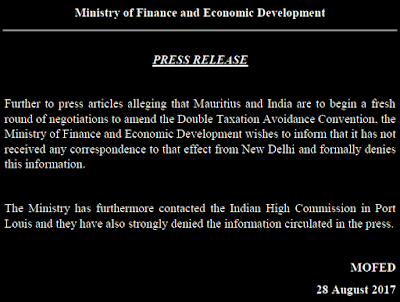
Mauritius: Communiqué in relation to Mauritius-India Double Taxation Avoidance Convention

Further to press articles alleging that Mauritius and India are to begin a fresh round of negotiations to amend the Double Taxation Avoidance Convention, the Ministry of Finance and Economic Development wishes to inform that it has not received any correspondence to that effect from New Delhi and formally denies this information. 

The Ministry has furthermore contacted the Indian High Commission in Port Louis and they have also strongly denied the information circulated in the press.


25 August 2017

Japan’s first resident Ambassador to Mauritius calls on the Prime Minister

The first Ambassador of Japan with residence in Mauritius, Mr Yoshiharu Kato, paid a courtesy call on the Prime Minister, Minister of Home Affairs, External Communications and National Development Unit, Minister of Finance and Economic Development, Mr Pravind Kumar Jugnauth, yesterday afternoon at the Treasury Building in Port Louis.

Discussions between the Prime Minister and the Ambassador centred around the strengthening of the good relations between Mauritius and Japan. The need to enhance collaboration in various sectors was also highlighted. Mr Kato recalled that the first Japanese Embassy in Mauritius opened this year, and stated that he was honoured, as the first Resident Ambassador, to have been granted an audience with the Prime Minister.

Earlier, the Ambassador presented his credentials to the President of the Republic of Mauritius, Dr. Ameenah Gurib-Fakim.

The newly appointed Ambassador joined the Japanese Ministry of Foreign Affairs in 1980. He served in various positions including Senior Deputy Director and Senior Regional Coordinator at the Second Southeast Asia Division of the Southeast and Southwest Asian Affairs Department in the Asian and Oceanian Affairs Bureau. Prior to his posting to Mauritius, Mr Kato was Consul-General of Japan in Surabaya in Indonesia.

Japanese – Mauritian Relations

Diplomatic relations between Mauritius and Japan were established in 1969. Through the Japan International Cooperation Agency (JICA), the Land of the rising sun has been providing technical assistance to Mauritius in several areas, namely disaster risk management, coastal protection and rehabilitation programme, and landslide management.

In July 2017, the State Minister for Land, Infrastructure, Transport and Tourism of Japan, Mr. Shinsuke Suematsu, was on official visit to Mauritius, accompanied by a delegation of representatives of 15 Japanese companies. A Memorandum of Cooperation to promote collaboration in the field of public infrastructure, transport and quality infrastructure investment was then signed with the Ministry of Public Infrastructure and Land Transport. Representatives of the Japanese companies also participated in business meet and networking session organised by the Board of Investment.

24 August 2017

Mauritius rated as an OECD Compliant Jurisdiction

Mauritius has been acclaimed for its continued commitment to implement the international standards of transparency and exchange of information for tax purposes. The country was rated as an Organisation for Economic Cooperation and Development (OECD) Compliant jurisdiction on 21 August 2017 by the Global Forum on Transparency and Exchange of Information for Tax Purposes.

The Global Forum conducted an enhanced peer review process aimed at assessing compliance with international standards for the exchange of information on request between tax authorities. After a thorough process during which the Global Forum assessed the legal and regulatory framework for information exchange (Phase 1), as well as, the actual practices and procedures (Phase 2), Mauritius has been classified as compliant with international standards and norms regarding transparency and exchange of information for tax purposes.

The Forum reviewed exchange of information practices through combined peer review reports in ten jurisdictions. Three jurisdictions namely Mauritius, Ireland and Norway received an overall rating of “Compliant” while six others that is Australia, Bermuda, Canada, Cayman Islands, Germany and Qatar were rated “Largely Compliant.” Jamaica was rated “Partially Compliant,” leading the Global Forum to launch a supplementary report on follow-up measures to ensure a higher level of compliance.

According to the survey, Mauritius has over the years continuously upgraded its legal and regulatory framework and ensured the practical implementation of its framework in view of becoming an OECD Compliant jurisdiction. Rated as a Largely Compliant jurisdiction in 2014, Mauritius has implemented a number of measures leading to its upgrade to “Compliant” status.

It further highlighted that Mauritius appears amongst the only 3 jurisdictions (Ireland, Mauritius, Norway) being upgraded after a second round of reviews by the Global Forum in August 2017 and the country upholds its exchange of information practices in line with the best international norms and practices.

The Financial Services Commission, as the integrated regulator for the non-bank financial services sector, is fully committed to abide by international norms and standards to ensure the sound repute and credibility of the Mauritius International Financial Centre.

Global Forum

Global Forum members are working together to monitor and review implementation of the international standard for the automatic exchange of financial account information, under the Common Reporting Standard  which will start in September 2017. The monitoring and review process aimed at ensuring the effective and timely delivery of commitments made, the confidentiality of information exchanged and to identify areas where support is needed.  

The Forum is assisting developing country members to ensure that they can also receive the benefits of the ongoing global move to automatic exchange of financial account information.

22 August 2017

Bloomberg: Could Puerto Rico Be the Next Hot Tax Haven?

A loophole may make it a good place for foreigners to keep cash.

Bloomberg

FSC Mauritius issues Communiqué in relation to the upgrade of Mauritius to an OECD Compliant Jurisdiction

The Global Forum on Transparency and Exchange of Information for Tax Purposes (Global Forum) conducted an enhanced peer review process aimed at assessing compliance with international standards for the exchange of information on request between tax authorities.

After a thorough process during which the Global Forum assessed the legal and regulatory framework for information exchange (Phase 1), as well as, the actual practices and procedures (Phase 2), Mauritius has been rated as an OECD Compliant jurisdiction on 21 August 2017.

Over the years, Mauritius has continuously upgraded its legal and regulatory framework and ensured the practical implementation of its framework in view of becoming an OECD Compliant jurisdiction.

Rated as a Largely Compliant jurisdiction in 2014, Mauritius has implemented a number of measures leading to its upgrade to “Compliant” status. Mauritius appears amongst the only 3 jurisdictions (Ireland, Mauritius, Norway) being upgraded after a second round of reviews by the Global Forum in August 2017. Mauritius upholds its exchange of information practices in line with the best international norms and practices.

The Financial Services Commission, as the integrated regulator for the non-bank financial services sector, is fully committed to abide by international norms and standards to ensure the sound repute and credibility of the Mauritius International Financial Centre.


21 August 2017

Global Forum releases second round of compliance ratings on tax transparency for 10 jurisdictions

The Global Forum on Transparency and Exchange of Information for Tax Purposes (the Global Forum) published today the first 10 outcomes of a new and enhanced peer review process aimed at assessing compliance with international standards for the exchange of information on request between tax authorities. 

The new round of peer reviews – launched in mid-2016 – follows a six-year process during which the Global Forum assessed the legal and regulatory framework for information exchange (Phase 1) as well as the actual practices and procedures (Phase 2) in 119 jurisdictions worldwide.

The Global Forum’s new peer review process combines the Phase 1 and Phase 2 elements into a single undertaking, with new focus on an assessment of the availability of and access by tax authorities to beneficial ownership information of all legal entities and arrangements, in line with the Financial Action Task Force international standard.  

The Global Forum reviewed exchange of information practices through combined peer review reports in ten jurisdictions Three jurisdictions – Ireland, Mauritius and Norway –  received an overall rating of “Compliant.” Six others – Australia, Bermuda, Canada, Cayman Islands, Germany and Qatar were rated “Largely Compliant.” Jamaica was rated “Partially Compliant,” leading the Global Forum to launch a supplementary report on follow-up measures to ensure a higher level of compliance.

Global Forum members are working together to monitor and review implementation of the international standard for the automatic exchange of financial account information, under the Common Reporting Standard (CRS), which will start in September 2017. The monitoring and review process is intended to ensure the effective and timely delivery of commitments made, the confidentiality of information exchanged and to identify areas where support is needed.  

The Global Forum is assisting developing country members to ensure that they can also receive the benefits of the ongoing global move to automatic exchange of financial account information. 

From Soviets to Oligarchs: Inequality and Property in Russia, 1905-2016

This paper combines national accounts, survey, wealth and fiscal data (including recently released tax data on high-income taxpayers) in order to provide consistent series on the accumulation and distribution of income and wealth in Russia from the Soviet period until the present day. We find that official survey-based measures vastly under-estimate the rise of inequality since 1990. According to our benchmark estimates, top income shares are now similar to (or higher than) the levels observed in the United States. We also find that inequality has increased substantially more in Russia than in China and other ex-communist countries in Eastern Europe. We relate this finding to the specific transition strategy followed in Russia. According to our benchmark estimates, the wealth held offshore by rich Russians is about three times larger than official net foreign reserves, and is comparable in magnitude to total household financial assets held in Russia.

14 August 2017

IMF Staff Completes 2017 Article IV Mission to Mauritius

  • Real GDP growth in 2017 is projected at 3.9 percent on the back of dynamism in the construction sector.
  • The authorities seek to graduate Mauritius to a high-income economy within the next ten years on the basis of an ambitious public investment program and improvements to the business climate.
  • Attaining the next level of economic development will require Mauritius to use strong and independent institutions to overcome the variety of policy challenges outlined above.

An International Monetary Fund (IMF) mission led by Amadou Sy visited Port Louis and Ebène during July 31–August 15, 2017 to conduct the discussions for the 2017 Article IV consultation with Mauritius.

At the conclusion of the visit, Mr. Sy issued the following statement today in Port Louis:

The Mauritian economy continues to be robust and staff project economic activity for 2017 to remain in line with recent trends. However, Mauritius is facing a challenging environment and vulnerabilities are rising. Options to improve resilience include: (a) rebuilding the credibility of the fiscal anchor and creating fiscal space for infrastructure and human capital investment; (b) tackling inflationary pressures by tightening monetary policy, while modernizing the monetary policy framework to strengthen the policy response to shocks; (c) addressing financial stability risks, and (d) improving competitiveness to support growth.” 

The authorities seek to graduate Mauritius to a high-income economy within the next ten years on the basis of an ambitious public investment program and improvements to the business climate. Attaining the next level of economic development will require Mauritius to use strong and independent institutions to overcome the variety of policy challenges outlined above. Early signs are promising, with both the pending formation of the National Economic Development Board, and the drafting of the Financial Sector Blueprint, important welcome steps towards harmonizing the policy direction and implementation across sectors. Considering Mauritius’ track record of reinventing its economic model, there are grounds for optimism that the country will successfully manage the reform process.” 

Real GDP growth in 2017 is projected at 3.9 percent on the back of dynamism in the construction sector. Tourism and financial intermediation activities are expected to provide support, though at a slower pace than 2016. Domestic demand will continue to be supported by recovering business and consumer confidence, and increased public investment. However, falling sugar production and subdued exports would weigh down on agriculture and manufacturing activity. The capital and financial account has proven resilient in the face of the revised Double Taxation Avoidance Agreement (DTAA) with India, mainly owing to the grandfathering clause.

The fiscal stance remains expansionary. The overall budget deficit stood at 3.4 percent of GDP in FY2016/17, down from 3.6 percent of GDP in FY2015/16, mostly reflecting the underexecution of the capital budget and increased tax revenue mobilization. The primary balance (excluding grants) and the overall borrowing requirement deteriorated somewhat.  Total public debt remained constant at 65 percent of GDP. Staff recommends supplementing the planned fiscal consolidation with additional revenue mobilization efforts to strengthen the credibility of the fiscal anchor. Additional elements of a growth-friendly fiscal consolidation include improvements in public investment and debt management.

Inflation has picked up on the back of supply shocks, but there are signs of further building inflationary pressures. Headline inflation outcomes in the first half of the year surprised on the upside, and more than doubled to 5.3 percent year-on-year in July from 2.3 percent at the end of 2016, mostly driven by higher food and fuel prices, the increase in excises on tobacco and alcohol products. Headline inflation is expected to remain above 5 percent during the second half of 2017 onwards, mostly on account of second round effects.

Monetary policy is accommodative. The Key Repo Rate (KRR) has been kept constant at 4 percent in the last year. Nominal interest rates are at historically low levels, and real market interest rates are negative. The mission recommends tackling inflationary pressures by tightening monetary policy, while modernizing the monetary policy framework to strengthen policy response to shocks” 

The Global Business Sector is under pressure from international anti-tax avoidance initiatives. The authorities are undertaking efforts to address the concerns raised by the OECD and the EU in these matters. Prioritizing the adoption of the Blueprint for the Financial Services Sector, can help the GBC sector transition from a system based largely on tax incentives to one that provides higher value added services.” 

The overall current account deficit narrowed at the end of 2016 to 4.4 percent of GDP, reflecting strong tourism receipts and net income balances. Yet it is expected to widen over the medium-term, due to growing domestic demand, the high import component of the government’s investment program, and planned aircraft purchases. The team estimates that Mauritius’ external position at the end of 2016 was weaker than implied by medium-term fundamentals and desirable policies.  Staff recommends allowing more flexibility of the exchange rate to help address the emerging imbalances, and maintaining reserve coverage at least at 100 percent of the adequacy metric to safeguard external stability.

Mauritius has made great strides over the last decade to top the competitiveness rankings in Sub-Saharan Africa (SSA), but still lags emerging market peers as lackluster productivity and rapid real wage growth in recent years have reduced cost competitiveness.

The recently-adopted Business Facilitation Act is a welcome step to improve Mauritius’ business environment. Broader structural reforms in areas such as the labor market including the promotion of youth and female labor participation in the labor force, higher education and innovation policies will be key drivers of Mauritius’ economic transformation going forward.” 

The mission met with Prime Minister and Minister of Finance and Economic Development, Pravind Jugnauth, Minister of Financial Services, Good Governance and Institutional Reforms, Dharmendar Sesungkur, Governor of the Bank of Mauritius Rameswurlall Basant Roi, other senior government officials, as well as the private sector, academia, and civil society. The mission would like to thank the Mauritian authorities for their excellent cooperation, and the very productive discussions. The IMF stands ready to support the authorities’ reform efforts, including through the provision of technical assistance, and looks forward to a continued and fruitful policy dialogue in the period ahead.

Foodies Sacrifice Cost and Convenience for Quality

You might describe yourself as a “foodie” if you post photos of your avocado toast on social media or gift homemade jam with fruit from your garden. But being a “foodie” means much more than this.

According to the International Food Information Council (IFIC) Foundation’s 2017 Food and Health Survey, foodies are more confident in their nutrition know-how, will sacrifice cost and convenience to get foods that align with their values, and even define “healthy” differently than other types of consumers.

An analysis of purchase drivers from 2017 Food & Health Survey findings reveals six distinct groups of consumers, including foodies.  These profiles help us understand how different consumers think about and shop for food beyond traditional demographics, like age, income or gender. Other groups identified include pleasure shoppers, diligent searchers, product selectors, unbiased buyers and indifferent consumers.

You Might Be a Foodie If…

According to the Food and Health Survey, a foodie is someone who sacrifices convenience and cost in search of a quality product, particularly one that is tasty, healthy, and made in a way that aligns with their personal beliefs.

Foodies also have a different definition of healthy food compared to other Americans. While the other five profile groupings consider a healthy food to be “part of an important food group,” foodies are the only group to include “minimally processed” in their top three attributes of a healthy food. Foodies also chose “free from artificial ingredients, additives” and “high in healthy components or nutrients,” rounding out their definition of healthy.

Foodies are also more confident in their nutrition know-how. While only 44 percent of the general population could name a food or nutrient associated with their most desired health benefit, 60 percent of foodies were able to do so. In addition, when confronted with conflicting nutrition information, this group was among the least likely to doubt their food decisions.

Other groups prioritize the cost and convenience of food while foodies are more likely to sacrifice these purchase drivers for quality. They are also not as concerned with sustainability or packaging. However, for foodies, taste still reigns supreme when deciding to purchase a food or beverage.

According to the survey, foodies are predominately female (63% female vs. 37% male), have higher incomes (52% make more than $75,000 a year) and a median age of 58. They are also less likely to have kids under 18. This might partially explain why foodies aren’t as concerned about convenience or the cost of food.

As in previous years, the Food and Health Survey has shown us what drives consumers in their food purchasing decisions, but this is the first year we took a look at how foodies distinguish themselves from consumers generally,” said Alexandra Lewin-Zwerdling, Ph.D., vice president of research and partnerships at the IFIC Foundation. “Our hope is that by better understanding the attitudes, perceptions, and habits behind consumer behavior, we can work with partners to enhance and develop effective nutrition education strategies.

10 August 2017

Mémento: L'île Maurice se modernise

Le gouvernement mauricien se donne-t-il les moyens de réaliser ses ambitions? 

 Numéro Spécial Ile Maurice

04 August 2017

MCB Review of charges as from 4th September 2017 - Global Business

TransactionCurrent PricingReviewed Pricing
Overseas Banks’ charges relative to International Transfers (SWIFT) in USD and EURO respectivelyUSD 12.50USD 25
EUR 10 / EUR 15< EUR 50,000EUR 22
> EUR 50,000EUR 40
Outward Telegraphic Transfer through Internet Banking0.125%, minimum USD 25 / maximum USD 650.125%, minimum USD 30 / maximum USD 75
Outward Telegraphic Transfer through other channels0.15%, minimum USD 35 / maximum USD 800.15%, minimum USD 40 / maximum USD 85
Audit Confirmation (by email / post)< 1 year: USD 25 / > 1 year: USD 40< 1 year: USD 50 / > 1 year: USD 75
SWIFT transfer after cut-off time (Late payment fee)Not applicableUSD 100
Bank ReferenceUSD 25USD 50

03 August 2017

New report by TheCityUK reveals the considerable contribution the UK-based legal and accountancy sector makes to the UK’s public finances

In 2015/16 the UK-based legal and accountancy sector generated an estimated £15.5bn in tax – comprised of taxes borne (£6.4bn) and taxes collected (£9.1bn) – representing 2.5% of all UK tax receipts. This is roughly equivalent to total UK spending on police services. The report underlines Britain’s leading position in Europe as a legal and accounting hub.

According to the report, ‘Total Tax Contribution Study for UK legal and accounting activities’, which was produced by PwC, the sector collectively generated employment of 693,000 across the UK – nearly one quarter (23%) of EU employees in the sector are in the UK. Britain’s premier position as a legal and accounting services employer is trailed by Germany at 21% of the EU’s total sector jobs, then France (10%), Spain (8%) and Italy (7%).

Added together with the significant total tax contribution for the financial services sector, reported as £71.4bn in 2015/16, the estimated total tax contribution for UK-based financial, legal and accountancy services is £87bn.

Miles Celic, Chief Executive, TheCityUK, said,

The legal and accounting sector make a considerable contribution to the UK economy in their own right, and are an essential part of the world-leading financial and professional services ecosystem.

The UK is the leading global hub for legal and accounting expertise and it is vital that we not only preserve that, but we continue to grow it. This expertise isn’t just located in London. Right across the UK, centres of excellence, including Manchester, Bristol and Edinburgh, are adding value to the UK economy. These are also the areas we expect to see the most growth in the coming years as we move through Brexit and beyond.

In 2016, there were nearly 60,500 legal and accounting businesses in the UK with small to medium sized enterprises with fewer than 99 employees making up 99% of all firms.

The report from TheCityUK and PwC is the first such study to cover legal and accounting activities and highlights the importance of these activities to the UK economy.

Total Tax Contribution Study for UK legal and accounting activities