11 September 2018

Former Executive of Loyal Bank Ltd Pleads Guilty to Conspiring to Defraud the United States by Failing to Comply with Foreign Account Tax Compliance Act (FATCA)

Earlier today in federal court in Brooklyn, Adrian Baron, the former Chief Business Officer and former Chief Executive Officer of Loyal Bank Ltd, an off-shore bank with offices in Budapest, Hungary and Saint Vincent and the Grenadines, pleaded guilty to conspiring to defraud the United States by failing to comply with the Foreign Account Tax Compliance Act (FATCA). Baron was extradited to the United States from Hungary in July 2018. The guilty plea was entered before United States District Judge Kiyo A. Matsumoto.

Richard P. Donoghue, United States Attorney for the Eastern District of New York; Richard E. Zuckerman, Principal Deputy Assistant Attorney General of the Justice Department’s Tax Division; William F. Sweeney, Jr., Assistant Director-in-Charge, Federal Bureau of Investigation, New York Field Office (FBI); and James D. Robnett, Special Agent-in-Charge, Internal Revenue Service Criminal Investigation, New York (IRS-CI), announced the guilty plea. Mr. Donoghue thanked the U.S. Securities and Exchange Commission (SEC), both the New York Regional Office and the Washington, D.C. Office; the City of London Police; the U.K.’s Financial Conduct Authority and the Hungarian National Bureau of Investigation for their significant cooperation and assistance during the investigation.                         

FATCA is a federal law enacted in 2010 that requires foreign financial institutions to identify their U.S. customers and report information (FATCA Information) about financial accounts held by U.S. taxpayers either directly or through a foreign entity. FATCA’s primary aim is to prevent U.S. taxpayers from using foreign accounts to facilitate the commission of federal tax offenses.               

According to court documents, in June 2017, an undercover agent met with Baron and explained that he was a U.S. citizen involved in stock manipulation schemes and was interested in opening multiple corporate bank accounts at Loyal Bank. The undercover agent informed Baron that he did not want to appear on any of the account opening documents for his bank accounts at Loyal Bank, even though he would be the true owner of the accounts. Baron responded that Loyal Bank could open such accounts and provide debit cards linked to them.

In July 2017, the undercover agent again met with Baron and described how his stock manipulation scheme operated, including the need to circumvent the IRS’s reporting requirements under FATCA. During the meeting, Baron stated that Loyal Bank would not submit a FATCA declaration to regulators unless the paperwork indicated “obvious” U.S. involvement. Subsequently, in July and August 2017, Loyal Bank opened multiple bank accounts for the undercover agent. At no time did Baron or Loyal Bank request or collect FATCA Information from the undercover agent. 

Baron’s guilty plea represents the first-ever conviction for failing to comply with FATCA. When sentenced, Baron faces a maximum of five years in prison.

Baron is the second defendant to plead guilty in this case. On July 26, 2018, Arvinsingh Canaye, formerly the General Manager of Beaufort Management Services Ltd. in Mauritius, pleaded guilty to conspiracy to commit money laundering. 

The case is being handled by the Office’s Business and Securities Fraud Section.  Assistant United States Attorneys Jacquelyn M. Kasulis, Michael T. Keilty and David Gopstein are in charge of the prosecution. The Criminal Division’s Office of International Affairs provided significant assistance in this matter.

10 September 2018

Thomas Wright, Gabriel Zucman : The Exorbitant Tax Privilege

We estimate and attempt to explain the evolution of the taxes paid by U.S. multinationals on their foreign profits since 1966. In the oil sector, taxes paid to oil-producing States have been contained, allowing U.S. firms to earn high after-tax returns. Foreign taxes fell abruptly after the first Gulf War. In sectors other than oil, the effective foreign tax rate has fallen by half since the late 1990s. Almost half of this decline owes to the rise of profit shifting to tax havens. The low foreign taxes paid by U.S. multinationals can explain half of the U.S. cross-border return differential.

FSC issues Public Notice - Surrender of the Representative of Investment Adviser (Unrestricted) Licence in the name of Ms. Itysha Sharona Ramdoss

PUBLIC NOTICE

Surrender of the Representative of Investment Adviser (Unrestricted) Licence in the name of Ms. Itysha Sharona Ramdoss

The Financial Services Commission, Mauritius (the “FSC Mauritius”) wishes to inform the public that ROGERS CAPITAL INVESTMENT ADVISORS LTD, having its registered address at No. 5, President John Kennedy Street, Port Louis has surrendered the Representative of Investment Adviser (Unrestricted) Licence in the name of Ms. Itysha Sharona Ramdoss in accordance with section 28 (5) of the Financial Services Act (the “FSA”).

Pursuant to Section 28(9) of the Financial Services Act 2007, the public is hereby notified that the Representative of Investment Adviser (Unrestricted) Licence in the name of Ms. Itysha Sharona Ramdoss stand terminated with effect from 27 August 2018.

You may contact the FSC Mauritius for any further information.

Financial Services Commission, Mauritius
7 September 2018

Mauritius: FSC issues Investor Alert against unauthorised entities

Public Notice

INVESTOR ALERT

All entities providing non-banking financial services in Mauritius must be licensed/ authorised /registered or approved (‘regulated’) (as may be appropriate) by the Financial Services Commission, Mauritius (the ‘FSC Mauritius’).

Statement

The FSC Mauritius alerts members of the Public and all other Stakeholders to the fact that there may be a number of entities engaged in financial services or financial services business activities as defined under the Financial Services Act 2007 (‘the FSA’) which are operating without being regulated under the relevant Acts.

The FSC Mauritius urges the Public/Stakeholders to exercise necessary caution prior to undertaking any financial services or financial business activities, and to deal only with persons/entities which are duly regulated by the FSC Mauritius under the relevant Acts. The FSC Mauritius cautions the Public/Stakeholders that there are numerous risks associated in dealing with unregulated entities. These may include losing money invested through fraudulent means.

The legal position

The FSC Mauritius is empowered, under section 6 of the FSA to, inter alia:

(a) license, regulate, monitor and supervise the conduct of business activities in the financial services sector and of global business;
(b) carry out investigations and take measures to suppress illegal, dishounorable and improper practices, market abuse and financial fraud in relation to any activity in the financial services and global business sectors; and
(c) take measures for the better protection of consumers of financial services.

All relevant entities wishing to engage or engaged in financial services shall apply for the appropriate licence(s)/authorisation/registration or approval for the conduct of their respective businesses.

Action

The Public/Stakeholders are invited to consult the Register of Licensees available on the FSC Mauritius website through the link,


before dealing with any entity. They may also wish to check for any investor alerts or any communiqués posted on FSC Mauritius website.

Stakeholders and the Public are also invited to contact the FSC Mauritius at
fscmauritius@intnet.mu or on + 230 403 7000, should they hold any material information/evidence that any person/entity may be infringing the relevant provisions of the FSA. All communication with the FSC Mauritius will be treated as strictly confidential.

Financial Services Commission, Mauritius
10 September 2018

08 September 2018

India: SEBI publishes interim report of Working Group on “KYC Requirements for FPIs” for public comments

In press release No.37/2018 dated September 5, 2018 it was, inter-alia, stated that the working group constituted under the Chairmanship of Shri H. R. Khan, Deputy Governor (Retired), Reserve Bank of India has held wide consultations with various stakeholders on the various issues raised in the representations made in relation to SEBI Circular No.CIR/IMD/FPIC/CIR/P/2018/64 dated April 10, 2018 on Know Your Client (KYC) Requirements for Foreign Portfolio Investors (FPIs) and is in the process of giving its recommendations. 

The working group has now submitted its interim report to SEBI. 

A copy of the report is placed on the website www.sebi.gov.in.  

Comments from public are invited on the recommendations contained in the aforesaid report.  

The comments may be submitted to kycforfpi@sebi.gov.in on or before 12:00 Noon on September 17, 2018.

07 September 2018

IFC Jurisdictions

The unique characteristics of international financial centres mean their economies have a heavy reliance on financial services, both for the sector’s contribution to local GDP and employment. This infographic explores the relationship between each jurisdiction's population size and financial industry, charting the wealthiest in terms of GDP per capita.

Moneyland: Why Thieves And Crooks Now Rule The World And How To Take It Back

From ruined towns on the edge of Siberia, to Bond-villain lairs in Knightsbridge and Manhattan, something has gone wrong with the workings of the world. 

Once upon a time, if an official stole money, there wasn't much he could do with it. He could buy himself a new car or build himself a nice house or give it to his friends and family, but that was about it. If he kept stealing, the money would just pile up in his house until he had no rooms left to put it in, or it was eaten by mice. 

And then some bankers in London had a bright idea. 

Join the investigative journalist Oliver Bullough on a journey into Moneyland - the secret country of the lawless, stateless superrich. 

Learn how the institutions of Europe and the United States have become money-laundering operations, undermining the foundations of Western stability. Discover the true cost of being open for business no matter how corrupt and dangerous the customer. Meet the kleptocrats. Meet their awful children. And find out how heroic activists around the world are fighting back. 

This is the story of wealth and power in the 21st century. It isn't too late to change it.

Guardian Review

Moneyland by Oliver Bullough review – the shadow world of the super-rich

The Long Read

The real Goldfinger: the London banker who broke the world

The true story of how the City of London invented offshore banking – and set the rich free

06 September 2018

Nespresso revives Zimbabwe’s coffee production

Nespresso announced today a long-term investment plan to revive Zimbabwe’s coffee industry and stimulate the rural economy.

The company will provide training and technical assistance to 400 smallholder coffee farmers over the next five years, with the goal of increasing the country’s production of quality sustainable coffee.

Zimbabwe’s coffee sector is in danger of disappearing as the result of a sharp decline in production over the past 18 years, following a series of economic shocks affecting many of Zimbabwe’s agricultural industries.

Nespresso expects to buy more than 95% of the high quality coffee production of Zimbabwean smallholders this season. The coffee will be available to global consumers in 2019. Nespresso is already working with farmers for the next harvest, where it expects volumes to increase, marking a potential turning point for Zimbabwe’s coffee producers.

“We are investing in reviving coffee farming in different regions of the world, where adverse conditions have impacted the lives of farmers and their ability to grow and nurture their coffee industries. Zimbabwe has a long history of producing beautiful coffees and we are pleased to be working with farmers through our AAA Sustainable Quality Program to help bring this industry back to life,” says Jean-Marc Duvoisin, CEO of Nespresso.

Together with TechnoServe, an international non-profit organization specializing in business solutions to poverty, Nespresso is training farmers to revive their production through climate-smart, sustainable farming practices.

“We are honoured to partner with Nespresso and the farmers of Zimbabwe to help transform one of the country’s most promising sectors and share more of its incredible coffee with the world,” said TechnoServe President and CEO William Warshauer.

“In line with TechnoServe’s market-centered approach to reducing poverty, we know that better coffee will lead to better incomes, better lives, and better futures for the hardworking people of Zimbabwe.”

The revival of the Zimbabwean coffee industry is part of Nespresso’s commitment to investing in coffee communities to create sustainable sources of income, preserve the environment and ensure coffee availability for future generations. Nespresso’s investment in Zimbabwe follows similar efforts the company has made to revive coffee production in South Sudan and in former conflict zones of Colombia.

About the AAA Sustainable Quality™ Program

Nespresso works with farmers through its AAA Sustainable Quality™ Program, which aims to create long-term, sustainable quality through direct relationships with farmers. Nespresso currently works with more than 75,000 farmers who benefit from hands-on support from agronomists as they learn how to develop their businesses. Working together, the agronomists and farmers look at the best growing and management practices for their crops, including technical assistance in agricultural practices to ensure quality. Through their participation in the AAA Program, the farmers are able to improve their coffee quality and achieve better productivity and standards in environmental and social welfare.

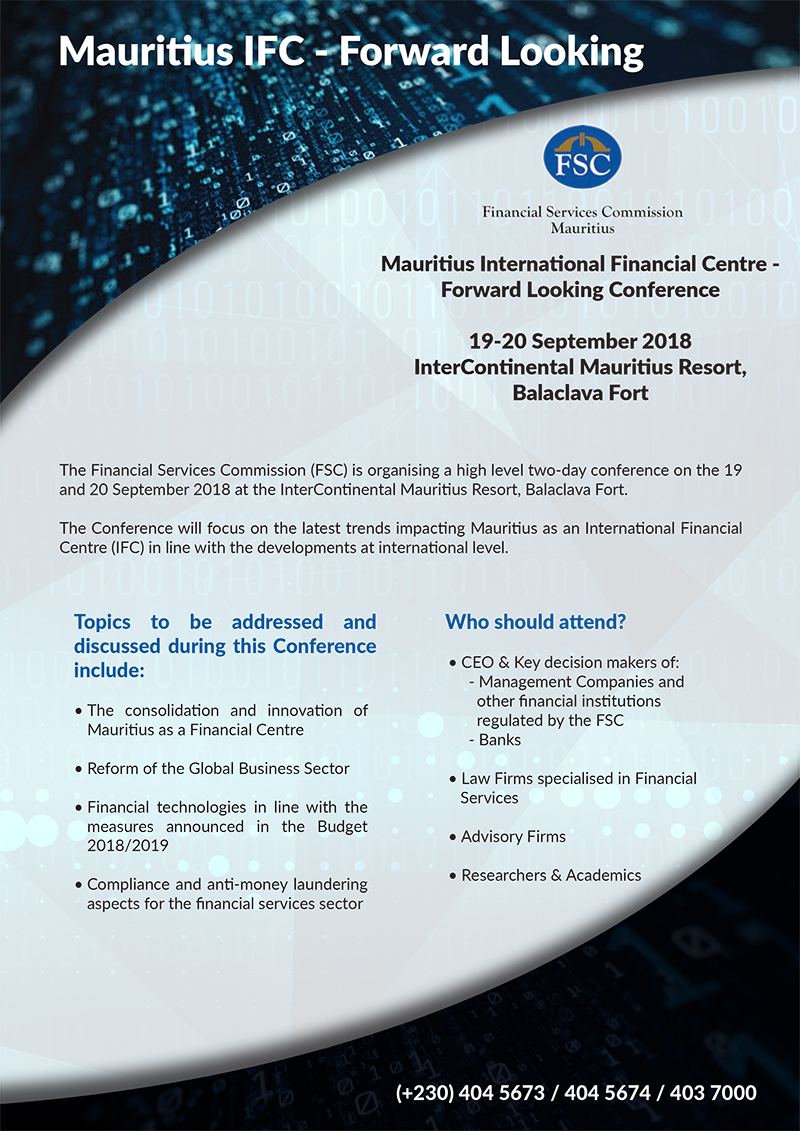
Mauritius International Financial Centre – Forward Looking Conference

The Financial Services Commission (FSC) is organising a high-level two-day conference on the 19 and 20 September 2018 at the InterContinental Mauritius Resort, Balaclava Fort.

The Conference will focus on the latest trends impacting Mauritius as an International Financial Centre (IFC) in line with the developments at international level.


05 September 2018

Raconteur: International Financial Centres 2018

From Guernsey to the Cayman Islands, offshore finance has long had a bad reputation. In recent years, however, far from being tax havens or hotbeds of dodgy dealings, these centres have become highly sophisticated and well regulated, rife with opportunities. The International Financial Centres report, published in The Times, explores how offshore funding is feeding into the UK’s smaller businesses, encouraging impact investing and offering exciting new roles for rising talent. Also covered is the effect new legislation is having on these unique centres.

Mauritius - Finance ​​InFocus: Newsletter September 2018 Issue 1​

The Ministry of Financial Services and Good Governance is pleased to introduce this first edition of its monthly newsletter. The launch of this newsletter is a major step for the Ministry to stay in touch with its different stakeholders, get their feedback and share concerns on issues of mutual interest. 

04 September 2018

Jersey Finance: The African FDI Opportunity

The commitment UK Prime Minister Theresa May made to invest £4bn into Africa during her visit to the continent last week should strike a chord with those familiar with Jersey’s international ambitions.

During her speech in South Africa, the UK PM highlighted that the UK would be making a "fundamental shift" in its strategic approach to Africa targeted aid, to focus more on long-term economic objectives.

The announcement came shortly after the Egyptian government had confirmed it was looking to increase its foreign direct investment by more than 40% to $11bn, with a view to creating 750,000 jobs, as part of a five year development plan. And just yesterday at the Forum on China-Africa Cooperation, China’s President Xi Jinping pledged £46bn in financing for projects in Africa as part of China’s efforts to link the continent’s economic prospects to its own.

The opportunities for Africa and its collective ambitions as a continent are clear, with the International Monetary Fund estimating that Africa could be a key performer this year. There are a number of very good reasons for this, not least the fact that growth in Africa is expected to accelerate to 3.5% this year, up from 2.9% in 2017, with nearly a third of African economies growing by around 5%. 

Meanwhile, leaders in Africa are increasingly serious about transparency and clamping down on corruption; Africa’s political landscape is liberalising; and the take-up of digital technologies by individuals and businesses across Africa is impressive.

There is clearly potential – but the flip side is that challenges still remain. As these latest commitments show, there is still a real need for foreign direct investment (FDI). It’s what we at Jersey Finance have been saying for years.

Back in 2015, we published an independent study that shed light on Jersey’s role in facilitating FDI around the world. It found that total global FDI by corporate investors stood at US$1.41 trillion in 2013, with such investment routed through IFCs at historically high levels, accounting for 6% of global FDI flows. 

It also found several African developing markets including Uganda, Mozambique, Egypt and Senegal benefit directly and indirectly from FDI originating from Jersey, to the tune of US$75.8 billion.

That report followed the publication in 2014 of the independent ‘Jersey’s Value to Africa’ paper. It found that Africa’s working age population is expected to double to 1.2 billion over the next 30 years and to support this, Africa will need to invest $85 trillion in infrastructure. 

At current levels of investment, it will fall $11.4 trillion short of that, with combined, aid, domestic profits and local governments able to plug less than half of this gap. The paper estimated that US$6.1 trillion would need to come from outside the continent through FDI with Jersey contributing between 0.5% and 1.5% of all foreign direct investment into the continent.

These finding still hold true - sourcing FDI into Africa is absolutely vital for Africa’s future. The commitments made by the UK and Egypt’s ambitions are absolutely a step in the right direction, but it is a small step in Africa’s journey and there is still much more that needs to be done. It is my prediction that high quality IFCs will need to play an increasingly important role in making sure that FDI reaches its intended destination and has maximum impact.

We feel strongly that Jersey has an important role to play in Africa’s future success, by providing a strong, robust, high quality platform to enable institutional investors to put their capital to work where it is most needed.

We took this message to London in the summer, at the Africa Financial Services Investment Conference (AFSIC) where we hosted a predominantly Jersey-based panel discussing the positive outlook of Jersey supporting African capital raising.

Earlier this year, we hosted a number of events in Nigeria, Kenya and South Africa, participated in the Africa Financial Services Investment Conference in London and took to the stage at the 4th Annual Private Equity in East Africa Conference in Nairobi to talk about how Jersey is supporting a growing number of African corporates and institutions looking to access global markets efficiently, safely and securely.

Later this year in October, we’ll be returning to South Africa to host two Roadshow events in Johannesburg and Cape Town to emphasise both our ability to support outbound African investment, but also to work with overseas investors to facilitate Africa-focused FDI and enable much-need capital to be put to work.

There’s no doubt that digital innovation, a burgeoning economically active population and global ambition have the potential to propel Africa to new heights – but that will need to be supported by considerable volumes of FDI, to support the necessary infrastructure investment that growth will require. The recent announcements from the UK and Egypt are acknowledgments of that. 

Centres like Jersey will need to play an increasingly vital role in enabling that to happen efficiently by providing the right expertise and regulatory framework to support high-quality inbound FDI to Africa.

03 September 2018

STEP: Worldwide freezing order cancelled after applicant found in breach of disclosure duty

The England and Wales High Court has voided a USD3-billion worldwide freezing order it granted to Angola's sovereign wealth fund FSDEA in April 2018.

The order was made against two individuals – FSDEA's former chairman José Filomeno dos Santos, and his business partner Jean-Claude Bastos de Morais – and 18 companies, all of them members of the Quantum group of companies. FSDEA accuses dos Santos of a 'dishonest conspiracy' with Bastos, who is the 95 per cent beneficial owner of the Quantum companies. It says that dos Santos gave USD5 billion to Quantum to manage and invest on FSDEA's behalf, but most of the money has either not been invested or has been channelled into other projects belonging to Bastos, 'to divert money from FSDEA into his pockets'.

Bastos and dos Santos claim they are merely victims of political change in Angola, and the current regime is trying to get its hands on money that the previous government invested with them. dos Santos himself is, in fact, the son of a former president of Angola who set up the fund in 2011, and appointed him to run it. That president stepped down in September 2017, after 38 years in power, and was replaced by President Lourenco.

The defendants approached the court to have the freezing order set aside on jurisdictional grounds. They also argued that FSDEA had not established a good arguable case in respect of some of the causes of action or established a sufficient risk of dissipation, as well as the breach of the duty of full and frank disclosure.

The judge ultimately found eight counts of 'non-disclosure and an unfair presentation,' which undermined FSDEA's case for the freezing order. He found FSDEA in 'serious and substantial' breach of its disclosure obligations. There was also no solid evidence that there was enough of a risk of dissipation of assets to justify a freezing order.

'The breaches of duty are sufficiently serious and culpable to warrant discharging the order and not granting fresh relief, irrespective of the other grounds of challenge', commented Popplewell J. Proper disclosure would have put a very different complexion on FSDEA's application for the order, he said, and duly discharged the order (Fundo Soberano De Angola v dos Santos, 2018 EWHC 2199 Comm).

Sources

27 August 2018

IMF - Banking in a Steady State of Low Growth and Interest Rates

A prolonged low-interest-rate environment presents a significant challenge to banks and is likely to entail major changes to their business models over the long-run. Lower returns to maturity transformation in the face of flatter yield curves and an inability to offer deposit rates significantly below zero combine to compress bank earnings in this environment. Smaller, deposit-funded, less diversified banks are hurt most, increasing consolidation pressures and reach-for-yield incentives, presenting new financial stability challenges.To the extent that such an economic environment reflects a new, steady-state with lower equilibrium growth driven by population aging and slower productivity growth, lower credit demand is likely to drive banking toward provision of fee-based, utility services.

IMF - Monetary Policy with Negative Interest Rates: Decoupling Cash from Electronic Money

Monetary policy space remains constrained by the lower bound in many countries, limiting the policy options available to address future deflationary shocks. The existence of cash prevents central banks from cutting interest rates much below zero. In this paper, we consider the practical feasibility of recent proposals for decoupling cash from electronic money to achieve a negative yield on cash which would remove the lower bound constraint on monetary policy. We discuss how central banks could design and operate such a system, and raise some unanswered questions.

26 August 2018

L'île Maurice, le paradis de la «criminalité en col blanc»

Samedi 25 août sur une radio privée, Basant Roi, Gouverneur de la Banque de Maurice a affirmé qu’il se peut que le montant d’argent sale dépasse les estimations de la MRA qui est de 35 milliards. Alors qu’on se focalise uniquement sur les provenances liées au trafic de drogue illicites, il se pourrait que la criminalité en col blanc soit beaucoup plus profitable. Tout comme nos hommes politiques parlent beaucoup de l'évasion fiscale des particuliers, mais peu de celle des entreprises.

24 August 2018

Mauritius: FSC issues Practice Notes regarding Corporate Trusteeship Services

The objective of these Practice Notes (the “Notes”) is to provide for the implementation of a common set of standards for Qualified Trustees and Management Companies (“Trust Services Providers - TSPs”) when they provide corporate trusteeship services.

23 August 2018

Royal Reserve Collection: King In The North

Brewery Ommegang and HBO Licensing & Retail have announced the newest beer in their collaborative series inspired by the award-winning drama Game of Thrones. King in the North, a beer brewed for Jon Snow, is the fourth and final beer in this year’s Royal Reserve Collection, a series of four limited release beers, each designed and brewed as an homage to one of four epic figures engaged in the battle for the Seven Kingdoms.

Brewed to sustain a leader through a long, dark night, King in the North is a barrel-aged imperial stout. The beer will be available at the brewery and at retail as of Black Friday, November 23, on draft and in 750ml bottles. The suggested retail price per bottle is $12.99.

King in the North will be released alongside a one-of-a-kind gift pack, just in time for the holidays. The gift pack features one 12-ounce bottle of each of the four Royal Reserve Collection beers and a collectible Game of Thrones glass. The suggested retail price for a gift pack is $24.99.

“There was only one character with whom we could end the Royal Reserve Collection,” said Doug Campbell, Brewery Ommegang president. “I don’t think we’re alone in our hopes for Jon Snow. And for those who missed one of the Collection during the year, we’re pleased to offer the opportunity to get all four at once, along with a glass in which to serve them.”

“We’ve now arrived at our fourth and final Royal Reserve beer which celebrates Jon Snow with a big, bold, barrel-aged stout for the long cold nights to come,” said Jeff Peters, vice president of licensing & retail at HBO. “We expect this one to bring our fans to their feet to toast the King in the North!”

King in the North pours jet black with a thick tan head. Aromas of roasted malt, coffee, and chocolate blend with those of oak, bourbon, and vanilla. The flavour is rich and full with notes of chocolate, vanilla, coffee, and roasted malt up front followed by smooth bourbon and a hint of oak. The finish is thick and chewy with oatmeal creaminess, and pleasant lingering roast. King in the North pairs well with funky aged cheeses, rich dark meats and decadent desserts. It also makes a great dessert on its own.

The Royal Reserve Collection features four new beers in the brewery’s Game of Thrones-inspired series with HBO. All of the beers will be available on draft and in 750ml bottles. The series began in April with Hand of the Queen, a barleywine, and was followed in June by Queen of the Seven Kingdoms, a sour blonde blend. Mother of Dragons, a smoked porter and kriek blend, will arrive in September before King in the North and the gift pack.

22 August 2018

English Court of Appeal Denies Angolan Sovereign Wealth Fund Bid to Reinstate Worldwide Freezing Order Against Quantum Global

The English Court of Appeal denied a request for permission to appeal by the Angolan sovereign wealth fund to reinstate a $560 million worldwide freezing order against Quantum Global, the fund manager, and its chairman Jean-Claude Bastos de Morais.

The Court of Appeal further ordered costs against the Fundo Soberano de Angola (FSDEA) in relation to its request.

The Court of Appeal’s decision essentially means that most of the FSDEA’s underlying claim has failed in the UK.

During the original hearing last month, Quantum Global presented evidence in court showing that it had managed the FSDEA funds under valid contracts with rigorous and transparent reporting, that its fees were in line with industry standards, that the mandate was won after a proper selection process and that any conflicts of interest were properly declared.

Quantum Global is still challenging similar court injunctions in Mauritius, which have prevented the company from managing its investments in Africa and paying its staff for five months. Unlike the UK case where Quantum Global successfully challenged the misleading claims made against it, the Mauritius authorities have refused officially to disclose the reason for the injunctions despite repeated calls for a fair hearing according to due process of law.

African Blockchain Report 2018

The African Blockchain Report 2018 takes a look at the early pioneers of the technology across Africa, highlighting some of its potential use cases and applications, as well as exposing some of the challenges that lie ahead.

Find out why blockchain is being postioned alongside the cloud, Internet of things (IoT) and Artificial Intelligence (AI) as the emerging technologies that will help build a bright digital future for Africa.