31 May 2016

Wärtsilä supplies 67 MW Smart Power Generation power plant to Mauritius

Wärtsilä will supply a 67 MW Smart Power Generation plant to Mauritius. The order includes four Wärtsilä 46 engines running on heavy fuel oil. The equipment will be delivered in late 2016, and the plant is scheduled to be operational by September 2017. 


Wärtsilä has been our trustworthy and professional partner for over 10 years. Their solutions are among the best in the market for producing reliable and highly efficient electricity with low emissions and low noise levels,” says Martin Kok Jensen, Sales and Marketing Director at Burmeister & Wain Scandinavian Contractor A/S (BWSC). The company is the EPC contractor for this project for which Wärtsilä will deliver the engines, equipment and engineering.

Economic growth and a growing tourism industry have caused an increase in energy consumption in Mauritius. To meet the rising demand, the retired diesel generating sets at the St Louis Power Station will be replaced with Wärtsilä engines. The reliability of the grid is extremely important for an insular country like Mauritius. The modernised power station will provide semi-baseload power, including daily starts and stops, to the local residents and industries. 

According to Bloomberg New Energy Finance, the country has set a target of having renewable energy comprise 35% of the total power generated by 2025. “By compensating for the gaps in the intermittent output of renewable sources, this fast-reacting plant will be able to support in renewable energy integration,” says Joost Bos, Business Development Manager at Wärtsilä.

Upon completion of this project, Wärtsilä and BWSC’s joint track record in Mauritius will be a significant 200 MW, which represents some 25 percent of the country’s total capacity. In Africa, Wärtsilä’s total installed base is 6500 MW in 46 countries.

Richard Samuel - Banks, politics, and the financial crisis: a demand for culture change (Part 1)

On 31 December 2015 the FCA abandoned the Thematic Review of Banking Culture it had in its business plan for that the following year, leaving the issue of culture change to the BSB/BSRC – in other words to the banks themselves. The reaction of the public so far suggests a further collapse in trust in both regulator and banks. Will this really go away?


Richard Samuel is a barrister at 3 Hare Court, London. His article ‘Tools for changing banking culture: FCA are you listening? Why the FCA’s IRHP mass dispute resolution system has failed and what the FCA can do about it’ is published in Capital Markets Law Journal (Volume 11, Issue 2)

Moody's: Mauritius's resilient economy and ample liquidity support its Baa1 rating

Mauritius's diversified and resilient economy support its Baa1 rating with a stable outlook in the face of an unfavorable external environment, Moody's Investors Service ("Moody's") said in an annual report published in the past week.

The country has successfully attracted foreign investment, mainly in the financial sector, in part due to its proactive efforts to create a business friendly environment. Its stable political environment and diversified exports are also supportive.

The report, "Credit Analysis -- Government of Mauritius", is now available for Moody's subscribers. The research is an update to the markets and does not constitute a rating action.

"Mauritius's relative economic diversification and wealth, as well as the authorities' proactive economic policy stance have been key supports," said Lucie Villa, Vice President -- Senior Analyst and the report's co-author. "Yet despite Mauritius's undeniable economic success, there are still structural constraints to higher levels of growth, especially related to infrastructure shortcomings, and deficiencies in the labor market, among other areas."

The Indian Ocean island nation's economic outlook remains healthy, and Moody's forecasts real growth for 2016 and 2017 of 3.6% and 3.7%. The announced changes to the Double Taxation Avoidance Agreement ("DTAA") with India will likely only have a modest impact on growth due to the country's sectoral and geographic diversification.

A substantial deterioration of government debt metrics or increased external vulnerabilities would exert downward pressure on the Mauritian government's rating. Conversely, a significant and permanent reduction in Mauritius's vulnerability to external volatility and shocks would put positive pressure on the rating.

Mauritius's complex financial sector constitutes its main source of systemic risk, and while a potential vulnerability, the sector has been the principal source of foreign exchange earnings.

The authorities face the challenge of continuing to foster investment, critical for ensuring Mauritius's macroeconomic stability, and supporting the government's ability to raise funding and consolidate its finances.

Moody's assesses Mauritius's fiscal strength as "Moderate", reflecting a history of high government debt, which stood at 59% of GDP at the end of 2015. Debt affordability is moderately high.

Moody's believes that these metrics are unlikely to change within the coming two years.

The annual Credit Analysis elaborates on Mauritius's credit profile in terms of Economic Strength, Institutional Strength, Fiscal Strength and Susceptibility to Event Risk, which are the four main analytic factors in Moody's Sovereign Bond Rating Methodology.

30 May 2016

EY 2016 Worldwide Corporate Tax Guide

Governments worldwide continue to reform their tax codes at a historically rapid rate. Taxpayers need a current guide, such as the Worldwide Corporate Tax Guide, in such a shifting tax landscape, especially if they are contemplating new markets.

The content is straightforward. Chapter by chapter, from Afghanistan to Zimbabwe, we summarize corporate tax systems in 162 jurisdictions. The content is current on 1 January 2016, with exceptions noted.

WSJ: What is a bank? A series exploring the existential crisis facing banks in 2016

Banks are in the midst of an identity crisis. An exploration into the state of the banking business

ATMC: Malicious and Misleading TV Broadcast on the Mauritius Jurisdiction by India Today

The Association of Trust and Management Companies (ATMC) refers to the malicious and misleading TV broadcast on the Mauritius jurisdiction by India Today on 24 May 2016 entitled ‘How Agusta kickbacks were channelled from Mauritius into India’ (the “Broadcast”). We strongly condemn the Broadcast which in our view, amounts to cheap and sensationalist reporting masquerading as investigative journalism and wish to clarify as follows:

  1. The Broadcast solely and naively relies on the comments of one person to brush a wide canvas of deceit where it accuses a whole country of money laundering! Sweeping statements like ‘Mauritius is a fertile market for operatives like … courtesy of local laws’ or “Once the shell company is formed, the Mauritian kickbacks factory blossoms with hundreds of consultants suddenly available to work the scam” only highlights the gullibility of the two Indian under cover so-called reporters and the editors of India Today who just believed their interlocutor at face value!
  2. The objective of India Today seemed to have been to show how allegedly dodgy funds entered India through Mauritius without any control. We highlight that, in fact, stringent customer due diligence procedures prevail in Mauritius both at the onset of any business relationship and on an ongoing basis, including the identification of sources of funds. India Today appears to be totally unaware or has maliciously ignored the fact that Mauritius has been rated as “largely compliant” by the OECD’s Global Forum on Transparency and Exchange of Information for Tax purposes.
  3. India Today would surely remember the Satyam Computer Services (SCS) scandal that shocked India and the world in 2009 where the chairman of SCS, Ramalinga Raju confessed that the company's accounts had been falsified. The SCS scandal was an isolated criminal act. Would India Today blame India and its population for that scam as well? Did India Today consider the possibility of an isolated criminal act limited to their interviewee only involving falsified documents at any stage of the alleged scam or the possibility of funds having been channeled to Mauritius through A-rated banks and supported by genuine due diligence documents i.e where already clean money entered and left Mauritius?
  4. The Global Business sector in Mauritius is well regulated and India Today has provided no tangible reason/evidence to support its blatantly incorrect statement that a GBC1 could be “the key to funneling kickbacks.” It is a verifiable fact that a GBC1 is subject to enhanced due diligence when its objective is to invest in India. The two Mauritius companies allegedly linked to the scandal were Category 2 Global Business Licence companies (i.e GBC2) and NOT GBC1! A GBC2 company is not tax resident in Mauritius for treaty purposes and cannot therefore benefit under the Mauritius India tax treaty or any other treaty but is nevertheless subject to regulatory and reporting requirements to Mauritius authorities. In fact, India could fairly easily attempt to tax any income or gains of the GBC2 related to the funds transferred to India by the GBC2 companies! The India Today’s amateur sleuths are lucky that they did not pay for the advice that they received from the person they interviewed as his advice appears to not only be totally flawed but also factually incorrect!
  5. ML ADMINISTRATORS LTD is not a member of the ATMC and we draw attention to the Communiqué issued on 26th May 2016 by the Financial Services Commission of Mauritius in respect of this matter. 

India Today is entitled to its opinion relating to the person who was interviewed. The ATMC considers however that the Broadcast has caused prejudice to operators in the global business industry, to the reputation of Mauritius as an International Financial Centre and to Mauritius as a sovereign nation. The ATMC calls on India Today to do the honourable act of retracting its malicious statements that malign Mauritius as a whole.


29 May 2016

Fin du DTAT: Lorsque la communication devient déroutante…

La communication autour de ce qui est advenu au traité DTAT entre l’Inde et Maurice recèle une maladroite diversion. La critique épargne le responsable des malheurs qui frappent aujourd’hui notre secteur offshore. Les uns mettent de l’avant les grands efforts de l’Inde et l’argent qu’elle nous donne en consolation. Les autres tirent sur les manquements du négociateur. Pour la population, c’est de la communication poudre aux yeux.

Dan Maraye: “Le traité renégocié va porter un coup de frein au secteur offshore”

Notre invité de ce dimanche est Dan Maraye, expert comptable et observateur politique. Il partage son analyse sur le traité de non-double imposition renégocié par Maurice avec l’Inde et ses conséquences sur le secteur offshore local. 

Banque de Maurice: Une poussée d’inflation… sémantique

Est-ce bien à Week-End qu’était destinée la «patente» de la The Bank of Mauritius (BOM) ? Ou visait-elle à répondre par anticipation aux interpellations parlementaires de Raffick Sorefan?


28 May 2016

China Offshore 6th Annual Company Formation Guide 2016

China is seeing offshore incorporations increasing in an unprecedented pace in the past year, the selection of the jurisdictions is also expanded from popular to those not-so-popular locations. In the meantime, Chinese government has continued to loosen its exchange control; the internationalization of the Chinese yuan is also picking up the pace with the support of the central government. 

This guide has included substantial information of the offshore industry for you to dive deeper into the knowledge base. And as always, we wish this brochure would serve its purpose to become a platform for knowledge exchange and a source for information and experience sharing.


27 May 2016

Rajiv Servansingh: Open Letter to the Prime Minister of India Shri Narendra Modi

We are taking the liberty of writing this open letter to you although we are acutely aware that you must be extremely busy and preoccupied with the immensity of the task of governing the Republic of India at this most critical time of its history. Your frequent travels to foreign nations as indeed your first diplomatic initiatives for your inauguration as Prime Minister have been a clear indication of your concern to re-establish your country in its right and appropriate place in the new and shifting global order. India is today the fastest growing among the economic giants of the planet.

Excerpts:
Reassured by the regular pronouncements of several Indian leaders over the decades about the ‘special relationship’ between our two nations, we have developed - rather naively it turns out - a false sense of security based on the oft-repeated commitment that India would never undertake any action which would somehow hurt the interests of Mauritius. Maybe we should have been wiser and paid heed to the dictum that in the international power game there are indeed no permanent friends but only permanent interests...
The Mauritius-India ‘special relationship’ is so embedded in our history that even the British colonial authorities could not fail to reckon with it. When the colonial government in India imposed an import duty on sugar in 1895, the then Governor of Mauritius, Hubert EH Jerningham wrote the following to the Secretary of State for the Colonies on 24th November 1896: “ … call your attention to the fact that 250,000 Indians who are labourers... are entirely dependent upon that industry… whether India might not be approached with a view to at least giving other British dependencies, and especially a Colony like this which provides a means of existence to so large an Indian population, the benefit of an exemption.” O tempora! O mores! Oh the times! Oh the customs!...
Mauritius Times

Sushil Khushiram: The India Tax Treaty Amendment

The signature of an amending protocol to the India-Mauritius tax treaty has brought to a close a long and arduous process of negotiations between the countries, spanning over two decades.

Excerpts:
The terms of the Treaty Protocol amendment are widely at variance with the official line taken by the Mauritian authorities in negotiations until last year. Mauritius was willing to make two concessions, namely (i) to adopt a LOB, provided that capital gains tax exemption, termed as “sacrosanct”, is maintained, and that GAAR does not override Treaty provisions, and (ii) to accept a main purpose test for the interest clause. Mauritius was also agreeable to the latest revised standard of an automatic exchange of information...
Global business and related activities are estimated to account for up to 5% of GDP, of which Indian treaty business represents at least two thirds, or a value added of about Rs13 bn annually. To sustain global business sector growth in the event of declining share investments, it is hoped that Mauritius can transmute into a debt-based jurisdiction. A new avenue for debt-related investments into India could emerge on the strength of the broadened interest clause in the amended treaty, and of the continuing capital gains tax exemption on debt instruments...
Mauritius Times 

26 May 2016

Mauritius: FSC issues an Interim Direction to ML ADMINISTRATORS LTD with respect to Mr Shakil Fakeermahamod

The Financial Services Commission has today, 26 May 2016, issued an interim direction to ML ADMINISTRATORS LTD to remove Mr Shakil Fakeermahamod as its director and Money Laundering Reporting Officer.


25 May 2016

Bank of Mauritius: Guideline on Corporate Governance

The guideline is issued under the authority of section 50 of the Bank of Mauritius Act 2004 and section 100 of the Banking Act 2004. The guideline applies to banks, non-bank deposit-taking institutions and cash dealers. The guideline shall come into effect on 1 June 2016.


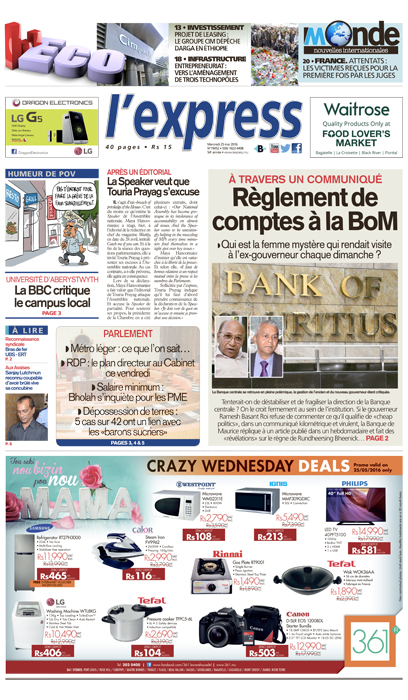
Dans un communiqué : la BoM règle ses comptes

Y aurait-il des tentatives pour déstabiliser la direction de la banque de Maurice (BoM)? C’est ce que l’on pense à la Banque centrale. Raison pour laquelle l’institution a répliqué, par un communiqué virulent et kilométrique, à un article publié dans un hebdomadaire, le week-end dernier, qui alléguait notamment que les finances de la banque seraient dans le rouge.


Sushil Khushiram - DTAA: Balance of payment effect

It is indispensable that a thorough review of the strategy and prospects for the financial services industry be conducted. The succession of negative shocks, foundering institutions, and a widening gap in policy credibility, are undermining the stability of the financial sector, which could lead to a searing crisis of confidence in the absence of corrective action.

24 May 2016

India Today: How Agusta kickbacks were channelled from Mauritius into India

While the probe by Indian agencies into the AgustaWestland VVIP chopper deal scandal continues at snail's pace, India Today has managed to dig in explosive revelations surrounding the country's biggest arms scandal since Bofors. 

India Today has managed to track down the cash trail in the AgustaWestland chopper deal to Mauritius.


IFC Review: “Disappointed” Protectors

Shan Warnock Smith and Andrew De La Rosa examine the role of trust protectors and provide an update on recent trust litigation cases.

FSC Mauritius issues Circular - Payment of fees 2016-17

The Commission hereby reminds all licensees / Registered / Authorised / Approved persons who are required to pay their annual licence renewal fee that the due date for payment of 2016/2017 licence fee is 1 July 2016.


23 May 2016

Bank of Mauritius - Public Notice: Response to a Press Article

The Bank of Mauritius notes that there is an on-going attempt to discredit its management. This Public Notice is not intended to cause prejudice to whomsoever and it must be read in that spirit.

In response to an article that appeared in a weekend newspaper making unwarranted allegations with regard to the operation of the Bank of Mauritius, the management wishes to provide the public at large with some clarifications.