11 December 2012

STEP Certificate in Foundations


Enabling professionals involved in the wealth planning industry to understand, establish and administer foundations.


Several international financial centres have introduced or plan to introduce legislation recognising the foundation concept in the coming years. This presents an opportunity for international wealth management professionals to add to the options they can offer to potential clients.
This course has been developed for those working in the wealth advisory community and while it is suitable for STEP members who might benefit from a better understanding of foundations it is also designed for private bankers, accountants, lawyers, trust managers and wealth managers generally.
Why should I study this qualification?

Completing the certificate will enable you and your organisation to:
  • Demonstrate to local regulatory authorities your competence with foundations
  • Manage risk effectively by ensuring procedural differences between foundations and trusts are preserved
  • Offer a more sophisticated wealth planning service to your current clients and expand your business by attracting a greater variety of clients
  • Describe the structure of foundations
  • Detail the differences and similarities between trusts and foundations
  • Identify when a foundation may be the most appropriate option to achieve a client’s aims
  • Demonstrate awareness of local foundation legislation
  • Identify the traps in creating and administering foundations for the unwary wealth professional


Where is this course available?

This certificate is delivered through an online learning platform providing access to webinars, forums and ‘chat’ facilities, and module-by-module self-assessment tools and so can be studied wherever you are based in the world.

10 December 2012

Bedell adds to its expertise in Mauritius with latest hire


Bedell has strengthened its private wealth management and funds team with the appointment of Marvin Pemsing who has wide ranging experience working for major financial institutions operating in Mauritius.

Marvin’s experience includes the setting up and administration of Mauritian global business companies, trusts, foundations and investment funds. He has a specialist understanding of the regulatory and financial services frameworks in Mauritius in relation to both banks and other finance industry institutions, and his wide ranging experience will further support the firm’s wealth management and funds offering. His role includes further developing and servicing Bedell’s clients and intermediaries internationally.

Fluent in both English and French, Marvin studied in London and holds a PGC in International Finance and a BA (Hons) Money, Banking and Finance. He has worked for a number of years in the finance industry in Mauritius for leading institutions such as HSBC Mauritius and most recently for Deutsche Bank.

Yuvraj Juwaheer, Partner and head of Bedell's Mauritius operations, commented:

"Marvin’s appointment in Mauritius strengthens our client service offering thanks to his extensive insights into the Mauritius financial services industry and the regulatory requirements associated with establishing investment vehicles. His network of contacts in Mauritius, India and the wider region will support our service offering available to clients worldwide. Marvin’s appointment gives added impetus to our growth plans and significantly enhances our capabilities."

PM opens Mauritius International Arbitration Conference 2012


Mauritius has a traditionally deep rooted respect for the rule of law said the Prime Minister, Dr Navinchandra Ramgoolam, this morning during the official opening of the Mauritius International Arbitration Conference 2012, which is being held on two days at the Intercontinental Hotel, Balaclava.

The Prime Minister recalled that Mauritius adopted in November 2008 state-of-the-art legislation based on the United Nations Commission on International Trade Law (UNCITRAL) Model Law, adapted to best serve the interests of international users, and concluded in April 2009 a Host Country Agreement with the Permanent Court of Arbitration (PCA) at The Hague pursuant to which the PCA has appointed a permanent representative in Mauritius.  Mauritius is now co-operating with a leading institution in the field of international arbitration to open a dedicated and state-of-the-art regional Centre for international arbitration.

The Mauritius International Arbitration Conference 2012 is jointly organised by the Government of Mauritius, the UNCITRAL, the PCA, the International Centre of Settlement Centre of Investment Disputes (ICSID), the International Chamber of Commerce, the International Council for Commercial Arbitration and the London Court of International Arbitration.  Some 300 participants, local and international are attending this Conference.

This event marks the successful continuation of the dynamic project launched in 2010, by the Government of Mauritius to create a new platform in the region for international commercial and investment arbitration.  As part of the project, Mauritius:
  • adopted state-of-the art legislation based on the UNCITRAL Model Law, adapted to best serve the interests of international users (November 2008);
  • concluded a Host Country Agreement with the Permanent Court of Arbitration of The Hague pursuant to which the PCA appointed to Mauritius its first overseas representative (April 2009);
  • hosted the inaugural Mauritius International Arbitration Conference in December 2010;
  • has cooperated with the London Court of International Arbitration (LCIA) to open a dedicated and state-of-the-art Centre for International Arbitration; and
  • successfully bid to host the 2016 Congress of the International Council for commercial Arbitration (June 2012)
From the unique perspective offered by Mauritius as a natural gateway into Africa, panels under the chairmanship of the heads of the co-hosting institutions will consider current and emerging issues in international arbitration under the theme An African Seat for the 21st Century.  Specifically, over two days:
  • Three panels on international commercial arbitration, chaired by the President of the ICC Court, the Director General of the LCIA and a senior member of the ICCA Council will engage in a critical examination of various aspects of the role of the courts: in giving effect to arbitration agreements, in supporting arbitral proceedings, and in the recognition and enforcement of awards.  A speaker on each panel will provide an African perspective on each topic.
  • Three panels on investment arbitration, chaired by the Secretary of UNCITRAL, Secretary-General of ICSID, the Secretary-General of the Permanent Court of Arbitration, will aim to provide a fresh perspective on arbitrator appointments and challenges, sovereign debt issues in investment treaty arbitration, and the management of regulatory risk.

07 December 2012

Joint statement from the Chief Ministers of Jersey and Guernsey regarding FATCA


The following joint statement has been issued by the Chief Minister of Jersey, Senator Ian Gorst, and the Chief Minister of Guernsey, Deputy Peter Harwood, on developments relating to the Foreign Account Tax Compliance Act (FATCA) and the UK Government:

As communicated last week, officials from Guernsey, Jersey and the Isle of Man continue to engage with US officials, aimed at concluding Intergovernmental Agreements under the US FATCA regulations.

We also share a common commitment with the UK to combat tax evasion and to participate in international efforts to combat financial and fiscal crime. We have long made it clear that neither Island has any wish to accommodate those engaged in tax evasion.

Senator Gorst added: “The UK Government is seeking to promote more widely as a new international standard the principles of the US Foreign Account Tax Compliance Act (FATCA). Jersey considers that it is important that in doing so the UK Government mirrors the approach of the US FATCA in being global in its application, ensuring a non-discriminatory approach for all jurisdictions.

In our ongoing discussions with the UK Government we will be pressing them to make clear the steps they are taking to promote the adoption of automatic exchange of information worldwide to ensure that a level playing field is achieved for all finance centres competing in the global market place.

Mauritius hosts 3rd FOCAC Legal Forum


The Attorney-General, Mr Y. Varma opened the Third Legal Forum on China-Africa Cooperation (FOCAC) yesterday, at the Grand Baie International Conference Centre in presence of Chief Justice Sik Yuen and other eminent personalities.The forum is being attended by some 250 participants from the legal profession from Africa, China and Mauritius.

In his speech, Mr Varma stated that the Forum should draw up standards commonly accepted by all partners and foster legal co-operation among them.This partnership should aim at promoting the rule of law and building contacts between legal communities in China and Africa. The rule of law assists economic development by providing certainty and contributes to social stability by protecting citizens against injustice, he added.

For his part Chief Justice Sik Yuen underlined that the purpose of this Forum is to encourage dialogue, cooperation and exchange with a view to seeking mutual reinforcement and common development in the legal and judicial fields.

The Forum on China-Africa Co-operation (FOCAC) is a platform established by China and African Countries for the promotion of collective consultation and cooperation mechanisms for the development of our respective countries. The theme of this forum is Deepening Culture – Africa legal Cooperation: The New China-Africa Strategic Partnership.

Through this partnership, the African and Chinese legal professionals are given a platform to exchange views, share experience and learn from each other.  This will thus contribute to mutual understanding and co-operation in the legal and judicial fields. Besides creating the opportunity for exchange purposes between African and Chinese Judges, Lawyers and Prosecutors, the partnership should promote awareness of legal reform issues.

As rightly acknowledged at the 2nd FOCAC Forum, in Beijing, in September 2010, a steady and reliable legal framework between China and Africa was an urgent need to support economic and trade relations.

One of the objectives of the Beijing Declaration at the FOCAC Legal Forum was to push forward the legal exchange and co-operation between both sides to actively promote the pragmatic legal co-operation between China and Africa and conduct co-operation like judicial assistance at bilateral level.

05 December 2012

UK: FSA consults on changes to the regulation and supervision of benchmarks


The Financial Services Authority (FSA) has proposed new rules and regulations for financial benchmarks. This follows the recommendations of the Wheatley Review of the London Interbank Offered Rate (LIBOR).

Benchmarks are used across financial markets in a broad range of activities.  They have historically been set by the financial markets themselves, and existed outside of any regulatory regime.  In the case of LIBOR, this industry-led approach has failed.  On 2 July 2012 the Chancellor of the Exchequer commissioned Martin Wheatley, managing director of the FSA and CEO designate of the Financial Conduct Authority (FCA), to undertake a review of the structure and governance of LIBOR and the corresponding criminal sanctions regime.

On 28 September 2012 ‘The Wheatley Review of LIBOR’ was published, which included a 10-point plan for comprehensive reform of LIBOR. One of its key recommendations was that while the setting of LIBOR should remain an industry-led activity; the submission to, and administration of, the rate should be regulated by the FCA. On 17 October 2012 the government accepted the Review’s recommendations in full, and amended the upcoming Financial Services Bill (the Bill) accordingly. 

The FSA has considered both the Wheatley Review recommendations and the Treasury’s proposed legislative amendments in designing an approach to regulating the setting of benchmarks. At least initially, the only ‘regulated benchmark’ in the UK will be LIBOR. However, the new regime provides a framework for regulation that can be extended to cover additional benchmarks in the future, were the government to consider it appropriate to do so.

The proposals include:
  • benchmark administrators will be required to corroborate submissions and monitor for any suspicious activity;
  • those submitting data to benchmarks will be required to have in place a clear conflicts of interest policy and appropriate systems and controls. This will result in clear, robust rules which will give firms and their employees comfort that the regulatory regime clarifies what is expected of them; and
  • two new significant influence controlled functions created under the FSA’s Approved Persons Regime for the administrator and submitting firms.
The FSA also seeks comments on ensuring the continuity of LIBOR and broadening participation in the rate. The Wheatley Review concluded that global markets benefit from the continuing participation of major firms in the LIBOR panels and that market integrity could be undermined if submitting firms were to leave them.  In addition the Review noted that larger panel sizes would benefit the accuracy and reliability of the benchmark.

As a consequence, the FSA has asked for feedback on how best to broaden the participation in LIBOR panels, including the use of the FCA’s powers to require firms to contribute to the rate on a permanent basis which the government is proposing to grant. As set out in chapter 4 of the Consultation Paper, it would be beneficial to the quality of the LIBOR benchmark, and therefore wider market integrity, if firms were to review their LIBOR participation against the FCA’s suggested criteria and approach the administrator with a view to submitting to LIBOR Panels if they concluded that this was appropriate.

Martin Wheatley, managing director of the FSA and CEO designate of the FCA, said:

Confidence and trust are critical to financial markets. The disturbing events uncovered in the manipulation of LIBOR have severely damaged that trust. Today’s proposals will bring in clear rules for the setting and governance of benchmarks and are a key step to ensuring the integrity of LIBOR.

04 December 2012

India: RBI signs MoU with Bank of Mauritius

The Reserve Bank of India and the Bank of Mauritius concluded a Memorandum of Understanding (MoU) on “Supervisory Cooperation and Exchange of Supervisory Information” on December 03, 2012. The MoU was signed by Shri G. Jaganmohan Rao, Chief General Manager-Charge, Department of Banking Supervision, RBI and Shri Ramsamy Chinniah, Head Supervision (On-site), Bank of Mauritius. With this, the number of such MoUs concluded by RBI has risen to 12. In the past, the RBI had signed MoUs with China Banking Regulatory Commission, Qatar Financial Centre Regulatory Authority, Dubai Financial Services Authority, South African Reserve Bank, Qatar Central Bank, Central Bank of Bahrain, Jersey Financial Services Commission, Financial Services Authority, U. K., Financial Services Authority, Norway (Sweden), Central Bank of Russian Federation and State Bank of Vietnam.

Jersey Finance CEO cements commercial ties with India


Geoff Cook, the CEO of Jersey Finance, is in India this week to further develop its commercial trade ties with India and to highlight Jersey’s finance industry’s strengths and regulatory and legal standards. Over the years, Jersey as an International Finance Centre, has become a customary gateway to European investment and wealth management with its high quality expertise and experience. In November 2011, Jersey signed a Tax Information Exchange Agreement (TIEA) with India, which established closer relationships with the Indian market. This was the 25th TIEA signed by Jersey.

Jersey is an Island close to the coast of northern France, but still a part the British Crown. The Island, which is a self-governing democracy, with one of the oldest parliaments in the Commonwealth, has developed a thriving financial services industry over the last 50 years, with particular strengths in banking, funds, private wealth management and capital markets. Jersey has no banking secrecy laws and it has been recognised in recent years as a well regulated centre by international bodies, such as the IMF, Financial Stability Board and OECD.

Jersey signed a Memorandum of Understanding (MoU) with the Reserve Bank of India in July 2012. This has led to further strengthen the relationship between the two jurisdictions and supports business opportunities for Jersey, as Indian businesses look to expand internationally and access capital on foreign exchanges.

Jersey Finance is sponsoring and participating in the International Taxation Conference on 6th December in Mumbai, where Geoff Cook, Chief Executive, Jersey Finance will be presenting on “Jersey – A Centre of Quality and Substance” covering Jersey’s strengths in Capital Markets activities using Jersey companies to list on international stock exchanges and also on Jersey’s private wealth expertise and experience which offers flexible estate and tax planning structures, protection of assets and confidentiality.

03 December 2012

UK: FSA consults on plans for temporary product intervention rules


The Financial Services Authority (FSA) is consulting on the approach the future Financial Conduct Authority (FCA) would take if it needed to exercise powers to make temporary rule changes, before consultation, relating to financial services products.

The Financial Services Bill specifically includes this power as part of the FCA’s toolkit. The FSA is consulting on its successor body’s behalf so that the FCA’s approach is clear and understood by April 2013 when the new regulator comes into being.  

Rules made before consultation would last for no longer than twelve months and could not be renewed. During this time, the FCA will either consult on a permanent remedy or aim to resolve the problem another way.

The consultation outlines some instances which may trigger temporary rules being made, including:

  • Where a product is in serious danger of being sold to the wrong customers, for instance where complex or niche products are sold to the mass market;  
  • Where a non-essential feature of a product seems to be causing serious problems for consumers;
  • Where a product is inherently flawed.
Product intervention rules (temporary or not) may address a wide range of product-related issues, for instance by restricting the marketing of a product to only certain types of customer or by requiring a product feature to be removed or changed in some way.  Where there is high risk to consumers, FCA might make a rule change to ban a product but it would only do so in very serious circumstances. Other possible interventions, which would not necessarily require changes to rules, would include issuing warnings, or using supervisory powers to require firms to amend promotional materials.

Martin Wheatley, managing director of the FSA and CEO-designate of the FCA, said:

Making temporary product intervention rules is not something that we expect to do often but having this power means we can act quickly and decisively.

The use of the power will be a judgement based on the need to protect all market users, consumers and industry innovators alike, from the type of products which will cause harm and might generate compensation costs.

The consultation runs until 4 February 2013.

Mauritius: FSC Communiqué following broadcast of interview of a director of a MC


Following the recent press article published in The Guardian newspaper of 25 November 2012 and the interview broadcast on BBC Panorama Programme on 26 November 2012 of a director of a Management Company licensed by the Financial Services Commission (“FSC”), the Commission received a request for additional information from an individual whose identity was not disclosed.

It is not in our policy to reply to “unknown individuals”, however, exceptionally, the FSC decided to respond to this request to explain the different regulatory and legal parameters available to ensure that its Licensees comply with requirements which are in line with international standards.

The FSC’s response can be found below:

Thank you for your query regarding the FSC’s licensing requirements. In fact, the FSC has a very rigorous licensing process. The requirements are designed to ensure international standards are met including areas such as know-your-client, the prevention of money laundering, terrorist financing and tax evasion.

As part of the process, applicants for a Management Licence are required to submit the following to ensure that officers and directors are fit and proper:

  • CVs of senior officers and Personal Questionnaire Form(s) for Directors, Managing Director/CEO, Compliance Officer, MLRO and Deputy MLRO. This information allows the FSC to ensure that officers and directors are fit and proper.
  • Submit information about the relevant competence/experience of its Directors/Senior Officers in Company and Trust formation, Administration and Management. In the event that the Directors/Senior Officers also hold employment in another institution/company/professional activity, they should disclose, and provide details as to how they will avoid any potential conflict of interest.
  • The directors, shareholders and officers of the Applicant may be required to submit a morality certificate.
Full details must also be disclosed on substantial shareholders and ultimate beneficial owners.

Applicants are also required to submit the following:
  • Business plan
  • Confirmation that the applicant shall implement a manual of internal control and compliance procedures, once it is licensed/authorized
  • Details of the arrangements to be put in place with respect to the day-to-day administration and management.
  • Applicant must undertake that it will have a duty of compliance to fulfill vis-à-vis the FSC with regard to clients' network and operations, and any infringement thereto must be forthwith notified to the Commission. It has to undertake furthermore that it will, at all times, ensure that the 'Four-Eyes Principle' is adhered to in the conduct of its business.
You can find more detailed information at the link below: 


As a point of technical clarification, the company you mention is licensed as a management company. It is not licensed as a trust. Management Companies act as intermediaries between licensed global business companies and the FSC. Please refer to the Trust Act for information on the requirements for corporate trusteeship at the following link:


Kindly note the following points:
  • In addition to licensing, the FSC actively supervises licensed companies through a risk-based framework. Our supervisory process has a number of elements to it including on-site inspections. The process is intended to ensure that the business of management companies are at all times in conformity with the stipulated conditions, norms of honourable conduct and with the laws of Mauritius as well as to ensure management companies are taking all reasonable measures and exercise due diligence to ensure that their clients are sound and reputable.
  • When a serious allegation is brought to our attention, whether from the media or another source, the FSC investigates the matter.
  • The FSC has enforcement powers including the power to revoke the licenses of management companies.
Regarding tax evasion, please note that this is illegal in Mauritius, and Mauritian authorities exchange information and cooperate with authorities in other jurisdictions in order to prevent such activities.

We trust you will find this information helpful and invite you to visit our website at http://www.fscmauritius.org. You will find information you may find of use such as our legislation and the number of MOUs the FSC has signed on information sharing. Again, thank you for your query, and please let us know if you require any further assistance.

30 November 2012

Guernsey: "Who 'regulates' the Financial Services Regulator?" Review


The Scrutiny Committee is commencing its review of the relationship between the States of Guernsey and the Guernsey Financial Services Commission with a public consultation exercise. The review will consider the relationship between the Government and the financial services regulator and assess the effectiveness of the States of Guernsey in providing an appropriate policy framework for regulation.

The panel appointed to undertake the review compromises the Committee’s Chair, Alderney Representative Paul Arditti and Deputies Rob Jones and Peter Sherbourne. The Committee Chair, Paul Arditti said:

The Committee has identified the oversight and policy framework for regulation provided by the Government to the financial services regulator as a subject worthy of review. The protection of the international reputation of the Bailiwick of Guernsey is of paramount importance and the responsibility for this ultimately rests with the States of Guernsey.

The regulatory policy framework in place for the financial services sector is a key element of this and the Committee wishes to assess the effectiveness of the Government in providing these policies and strategies and how it monitors whether they continue to meet the needs of the Bailiwick of Guernsey”.

The review's full Terms of Reference can be accessed at the following link:  Who 'regulates' the Financial Services Regulator? - Terms of Reference [144kb]

The Committee Chair, Paul Arditti said:

The review will consider the relationship between the States of Guernsey and the Guernsey Financial Services Commission to clarify and assess the governance arrangements in place, including reporting lines, responsibilities and accountabilities relating to financial regulation policy. It will also consider how financial regulation policy is developed by Government and implemented and how it measures the performance of the GFSC in regulating the financial services sector.

The Review Panel has launched a consultation inviting any individual or organisation who wishes to contribute to the review to provide a written submission on any, or all of the areas set out in the review’s terms of reference. The Committee Chair, Paul Arditti said:

This review presents the financial services industry, individuals, organisations and the public the opportunity to express their views on the appropriateness and effectiveness of the current financial services regulatory regime.

I would encourage any member of the public, businesses, business groups or consumer groups to engage with the Committee and contribute to this review. The consultation is a vital part of the information gathering process and will ensure the Panel has a range of views available to consider in its deliberations.

The consultation will close on Friday 1st February 2013. Any individual or organisation interested in providing a written submission to the Committee as part of this review may access a copy of the consultation document at the following link: Who 'regulates' the Financial Services Regulator? - Consultation document [173kb]

At the conclusion of the consultation period, the review panel will analyse the information received and determine whether it believes a public hearing with key stakeholders would be beneficial to gather additional evidence and to question the relevant Government Departments on findings and information received.

29 November 2012

UK: The Leveson Inquiry


The Prime Minister announced a two-part inquiry investigating the role of the press and police in the phone-hacking scandal, on 13 July 2011.

Lord Justice Leveson was appointed as Chairman of the Inquiry.  The first part will examine the culture, practices and ethics of the media. In particular, Lord Justice Leveson will examine the relationship of the press with the public, police and politicians.  He is assisted by a panel of six independent assessors with expertise in key issues being considered by the Inquiry.

The Inquiry has been established under the Inquiries Act 2005 and has the power to summon witnesses.  It is expected that a range of witnesses, including newspaper reporters, management, proprietors, police officers and politicians of all parties will give evidence under oath and in public.

It will make recommendations on the future of press regulation and governance consistent with maintaining freedom of the press and ensuring the highest ethical and professional standards.

Lord Justice Leveson opened the hearings on 14 November 2011, saying: “The press provides an essential check on all aspects of public life. That is why any failure within the media affects all of us. At the heart of this Inquiry, therefore, may be one simple question: who guards the guardians?


The Report has now been published at:


The Executive Summary has been published at: 


27 November 2012

US: EC Charges Four India-Based Brokerage Firms with Violating U.S. Registration Requirements


The Securities and Exchange Commission today charged four financial services firms based in India for providing brokerage services to institutional investors in the United States without being registered with the SEC as required under the federal securities laws.

The four firms – Ambit Capital Private Limited, Edelweiss Financial Services Limited, JM Financial Institutional Securities Private Limited, and Motilal Oswal Securities Limited – agreed to pay more than $1.8 million combined to settle the SEC’s charges.


The broker-dealer registration provisions are critical safeguards for the integrity of our securities markets,” said Scott W. Friestad, Associate Director of the SEC’s Division of Enforcement. “These four firms and all other foreign broker-dealers must educate themselves on the U.S. laws and regulations when they provide services to U.S. investors.

According to the SEC’s orders against the firms, they engaged with U.S. investors in some of the following ways despite being unregistered broker-dealers:
  • Sponsored conferences in the U.S.
  • Had employees travel regularly to the U.S. to meet with investors.
  • Traded securities of India-based issuers on behalf of U.S. investors
  • Participated in securities offerings from India-based issuers to U.S. investors.
In their respective settlements, the firms agreed to be censured while neither admitting nor denying the SEC’s charges. Ambit agreed to pay disgorgement and prejudgment interest totaling $30,910. Edelweiss agreed to pay $568,347. JM Financial agreed to pay $443,545. Motilal agreed to pay $821,594.

The firms’ cooperation with the Commission staff and their prompt remedial measures, including entering into Rule 15a-6 chaperoning agreements with U.S. registered broker-dealers and/or initiating registration with the Commission as a broker-dealer, were important factors in accepting the firms’ settlement offers, particularly the Commission’s decision not to impose a cease-and-desist order or a penalty,” said Mr. Friestad.

The SEC’s investigation, which is continuing to look for potential violations at other firms, has been conducted by Amy Friedman and supervised by Laura Josephs.

26 November 2012

Crown Dependency Regulators to maintain close co-operation


The Crown Dependencies’ financial services regulators will continue to work together to achieve common objectives in a number of key areas. That was an important outcome of the Annual Meeting of Regulators from Jersey, Guernsey and the Isle of Man, which was held recently in London.

The Directors General and senior officers are in regular contact with each other and discuss key operational factors facing the three Crown Dependencies. The annual meeting is an opportunity for the Boards and their executives to consider developments in the international industry and update each other on domestic issues.

The meeting, which was on this occasion chaired by Clive Jones of the Jersey Financial Services Commission, considered a number of topics including the work of the Group of International Finance Centre Supervisors, which is chaired by John Aspden, Chief Executive and Commissioner of the Isle of Man Financial Supervision Commission; legislative and regulatory updates; and government relations. The representatives shared their thoughts on the necessary level of communication to Industry, of what are to be considered high-risk clients, jurisdictions and sensitive activities.

The forum also discussed the need to maintain, jointly, the focus on demonstrating ‘equivalence’ with European Union regulations, whilst increasingly looking towards developments in the emerging markets of the BRIC countries.

Clive Jones, as Chair and on behalf of the meeting, said: “We consider it essential, whilst preserving our independent regulatory requirements, to maintain a regular dialogue and spirit of co-operation between the financial services regulators of the Crown Dependencies. There is considerable power and efficacy in sharing our knowledge and expertise to achieve common objectives that will benefit our jurisdictions individually and collectively. This meeting was extremely productive and further cemented our tripartite relationship.

Offshore secrets - Vince Cable promises to investigate offshore sham director industry

Business secretary says he is 'not complacent or naive' and will consider evidence being brought to light

Offshore secrets: how many companies do 'sham directors' control?

The Guardian/ICIJ offshore investigation has identified 'nominee' directors controlling thousands of companies across the world. But just how many are there?

FSA fines UBS £29.7 million for significant failings in not preventing large scale unauthorised trading


The Financial Services Authority (FSA) has fined UBS AG (UBS) £29.7 million (discounted from £42.4 million for early settlement) for systems and controls failings that allowed an employee to cause substantial losses totalling US$2.3 billion as a result of unauthorised trading. The trader, Kweku Adoboli, has been convicted of two counts of fraud by abuse of position and sentenced to seven years’ imprisonment. The systems and controls failings revealed serious weaknesses in the firm’s procedures, management systems and internal controls.

On 14 September 2011 UBS became aware that unauthorised trading had been carried out between 1 June 2011 and 14 September 2011 (the Relevant Period) on the Exchange Traded Funds Desk (the Desk) in the Global Synthetic Equities (GSE) trading division conducted from the London Branch of UBS.

The losses were incurred primarily on exchange traded index future positions.  The underlying positions were disguised by the use of late bookings of real trades, booking fictitious trades to internal accounts and the use of fictitious deferred settlement trades.

During the Relevant Period, there was insufficient focus on the key risks associated with unauthorised trading within the GSE business conducted from the London Branch. The significant control breakdowns allowed the trading to remain undetected for an extended period of time.

The FSA believes that UBS failed to take reasonable care to organise and control its affairs responsibly and effectively, with adequate risk management systems and failed to conduct its business from the London Branch with due skill, care and diligence.

In particular UBS' failings included:

  • The computerised system operated by UBS to assist in risk management was not effective in controlling the risk of unauthorised trading.
  • The trade capture and processing system had significant deficiencies, which Adoboli exploited in order to conceal his unauthorised trading. The system allowed trades to be booked to an internal counterparty without sufficient details, there were no effective methods in place to detect trades at material off-market prices and there was a lack of integration between systems.
  • There was an understanding amongst personnel supporting the Desk that the Operations Division's main role was that of facilitation. Their main focus was on efficiency as opposed to risk control and they did not adequately challenge the Front Office.
  • There was inadequate front office supervision. The supervision arrangements within GSE were poorly executed and ineffective.
  • The Desk breached the risk limits set for their desk without being disciplined for doing so. These limits represented a key control and defined the maximum level of risk that the Desk could enter into at a given time. This created a situation in which risk taking was not actively discouraged or penalised by those with supervisory responsibility.
  • Failing to investigate the underlying reasons for the substantial increase in profitability of the Desk despite the fact that this could not be explained by reference to the end of day risk positions.
  • Profit and loss suspensions to the value of $1.6 billion were requested by Adoboli during the course of August 2011. Prior to 18 August 2011, these were accepted without challenge or escalation. The combined factors of unexplained profitability and loss suspensions should have indicated the need for greater scrutiny.
  • These failings are particularly serious because:
  • Market confidence was put at risk, given the sudden announcement to the market and size of the losses announced. Negative announcements, such as this, put at risk the confidence which investors have in financial markets.
  • The systems and controls failings revealed serious weaknesses in the firm's procedures, management systems and internal controls.
  • The failings enabled Adoboli to commit financial crime.

Tracey McDermott, director of enforcement and financial crime, said:

"UBS's systems and controls were seriously defective. UBS failed to question the increasing revenue of the desk and failed to ensure that there was a corresponding increase in the controls in place over the desk. As a result Adoboli, a relatively junior trader, was allowed to take vast and risky market positions, and UBS failed to manage the risks around that properly. We know from past experience that failures to manage risk properly can cause firms to fail and cause systemic harm.

"Failures of this type in firms of the size and standing of UBS not only damage the firms concerned but also wider confidence in the integrity of the markets and the financial system. It is imperative that the markets we regulate are seen by investors to be orderly and a safe place to do business.

"This penalty - fixed at 15% of the revenue of the GSE trading division - is intended to make it clear that the FSA expects much higher standards from the firms we regulate."

In setting the level of the penalty, the FSA took into account the revenue generated by the business area where the poor controls occurred.

It also took into account the fact that in November 2009 UBS was fined £8 million for failings in relation to the systems and controls around the international wealth management business conducted with non-UK resident clients in the London branch of UBS.  The FSA expects firms to consider whether the issues identified in an enforcement action are applicable to other business areas and whether remedial action is necessary, UBS failed to do this.

UBS agreed to settle at an early stage and therefore qualified for a 30% discount under the FSA's executive settlement procedures. Were it not for this discount, the fine would have been £42.4 million.

UBS agreed to engage an independent firm to conduct a substantive investigation into the unauthorised trading incident, expending considerable resources (approximately £16 million to date) in doing so. UBS's new senior management has committed significant resources to undertake an extensive programme of remediation.

UBS has taken disciplinary action against employees who were involved in the events which gave rise to these breaches, including clawing back bonuses and withholding 50% of their deferred compensation from relevant individuals totalling more than £34 million.

The FSA conducted its investigation in coordination with the Swiss Financial Market Supervisory Authority (FINMA) which has also made its findings public. FINMA has also taken action against UBS in relation to the breach which is the subject of this Notice and UBS has undertaken to comply with the separate requirements imposed on it by FINMA.

25 November 2012

ICIJ: Offshore World Allows Some to Play Outside the Rules

The International Consortium of Investigative Journalists (ICIJ) today launches the first part of a multi-year project aimed at stripping away the biggest mystery associated with tax havens: the owners of anonymous companies. This first part of our project is being done in collaboration with The Guardian and the BBC and focuses on Britain -- one of the centers of the offshore industry.

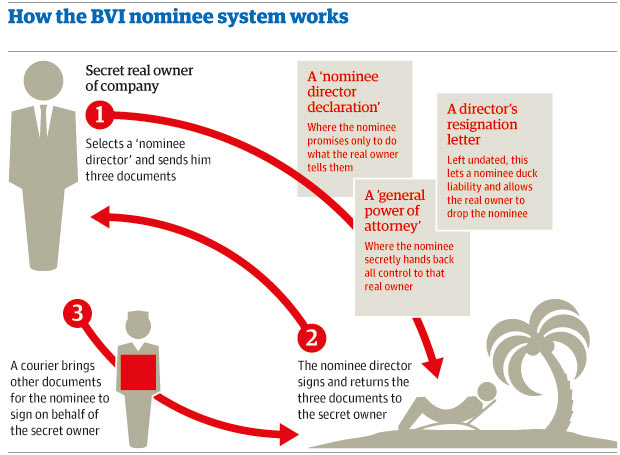
Offshore secrets - The offshore trick: how BVI 'nominee director' system works

Three pieces of paper are vital in setting up ready-made companies


Offshore secrets: British Virgin Islands, land of sand, sea and secrecy

Microstate is now the world's biggest provider of offshore entities, yet the UK refuses to step in and force it to reform