19 September 2018

Offshore Pilot Quarterly (September 2018, Volume 21 Number 3)

Dancing to the Pied Piper’s Tune

Irving Janis would have been appalled had he been alive today. This year the late psychologist would have reached 100 years of age and almost 50 years ago he introduced us to the term “groupthink” via his publication, “Victims of Groupthink”, which was published in 1972. George Orwell would probably have considered it a good read, he of the criticism of gumming together long strips of words provided by pernicious persuaders of sheer humbug. In his ground-breaking “Politics and the English Language Guide to Writing”, which was published over 70 years ago, he feared that the English language was already in a bad way (he was not to know how worse it would become in the twenty first century).

Charles Baudelaire, the nineteenth-century French poet and essayist, once said “If a word does not exist, invent it; but first be sure it does not exist”. Wise thoughts, but in today’s environment, with its lexiconic laxity, meanings of even existing words are reinvented; It was the twentieth-century American writer, John Steinbeck, and a Nobel laureate famous for his social perceptions, who said that “words can change their meanings right in front of you”. On that point, the United Kingdom no longer has an empire, and yet one can still become a member in 2018 of The Most Excellent Order of the British Empire, whereas the United States of America does not declare itself an empire, but it displays all the trappings of one. More challenges lie ahead, because we are adding over 1,000 new English words every year to our vocabulary of, already, more than one million words.

Accepting that persuasive writing or oratory can, in the wrong hands, become a dark art, it is important to note that collective decision-making can have its virtues – provided each participant travels along an independent-thinking path before arriving at a conclusion, a path along which I hope that most readers of my newsletter travel, rather than being led lemming-like by the hand.

We need not look too far into history to find just how groupthink, particularly in foreign policy, has produced disasters; the US invasion of Cuba’s Bay of Pigs; the escalation of the Vietnam War; and, more recently, on the economic front, the West’s 2008 financial crisis that Ben Bernanke, a former US Federal Reserve Bank Chairman, described as the “worst financial crisis in global history, including the Great Depression” which had, of course, direct financial consequences, but, as it turned out, profound political ones, too, that still resonate today and which has brought a surge of populism in its wake.

Huge economic risks built up and we found that the judgement of those we had assumed had a firm hand on the tiller, or the till, in the case of the bankers, proved illusory. Bankers, in a famous quote, continued to dance until the music stopped, lured like the children in Robert Browning’s “The Pied Piper of Hamelin”. This time it was a mountain of debt rather than a door in a mountain-side, that the investors faced. Crucially, the trust in both bankers and bureaucrats collapsed, leading to an upheaval of the political landscape in several countries. Admittedly, the ground had been rumbling for years before this earthquake struck.

This, indirectly, brought on the drive for goldfish-bowl transparency which has since become an all-out assault on privacy. Certainly, an effect of the 2008 financial crisis gave birth to a general public outrage when hundreds of millions of ordinary people lost their homes and jobs while the dancing bankers, despite everything, received their bonuses from banks which continued to be supported by their respective elected governments. Along with this anger came revelations of offshore chicanery and tax-dodging which went on to fan the flames. The Panama Papers came to light in 2016, to be followed by the Paradise Papers in 2017, and which prompted John Peterson, the head of the Organisation for Economic Co-operation and Development’s aggressive-tax-planning unit, to comment that “The Panama Papers and the Paradise Papers have focused the public’s attention on the global reach of the tax planning industry”. “Focused” has, of course, metamorphosed into fury.

Although supporting the revelations of, clearly, illegal activities, the sinister implications of unwarranted exposure got lost in the fog. Mr. Peterson’s public should have also focused its attention on the principles of confidentiality applicable to lawful activities also revealed by The International Consortium of Investigative Journalists from records containing privileged information and which had patently been stolen. This was a blatant breach of unjustified client confidentiality, without any thought of whether or not the released documents gave rise to any matter which fell within the normal definition of public interest.

This is just one illustration of what appears now to be a wilful disregard of privacy, such as Mark Zuckerberg’s instant message to a friend as long ago as 2004, after amassing personal data, including photos, emails and addresses of some 4,000 of his social network’s users: “They ‘trust me’… dumb f..ks”. Confidentiality is no longer of paramount importance and is another casualty of present-day mores.

A researcher from Cambridge University had been able to obtain approximately 300,000 Facebook users details in 2012 by encouraging them to download an app and take a survey. He then shared the data harvested with a political consultancy, Cambridge Analytica, which reportedly made this available to third parties, including Donald Trump’s presidential campaign. The ensuing scandal resulted in two hearings for Mr. Zuckerberg, first before a joint hearing of two Senate committees, and then a House of Representatives committee which opened up a can of worms. It turned out that about 87 million Facebook users, for example, were affected due to former policies of Facebook that had allowed people using a third-party’s app to share details about themselves and their friends too, but without their knowledge.

The politicians confronting Mr. Zuckerberg gave him an easy ride, and what we saw was a further example of ignorance winning the day: those on the committee at the hearings displayed how little they knew about Facebook, or the way that the world of digital communications operates. So Facebook was not brought to book. Did Mr. Zuckerberg mutter, I wonder, the same words, under his breath, inclusive of the expletive, that he once used to describe his social network users?

Politicians, not unlike government bureaucrats, are often in control of things they know far too little about, and I recall Mark Twain’s acerbic wit, when giving his view of his own government: “Suppose you were an idiot, and suppose you were a member of Congress; but I repeat myself”. It is a sentiment, I’m sure, that citizens of other countries sometimes express about their own government.

Whispered in the Closet

Irving Janis, George Orwell and John Steinbeck would have appreciated why the late Lord Carrington, a British foreign secretary and servant of six prime ministers, had said that his favourite book was “Alice’s Adventures in Wonderland”, because it helped remind him always of the absurdity of the world in which we live. Lewis Carroll, its author, famous for his children’s novels and nonsense verse, was a nineteenth-century mathematician and fellow at Oxford University who applied his logical and analytical mind to his love of paradox, creating many characters, such as the Queen of Hearts, Mad Hatter and the Cheshire Cat. Farce does indeed sit well with the times in which we live and had Carroll shared these times with us, he would have grinned as broadly as his Cheshire Cat because instead of Alice we surely occupy our very own Wonderland, one of amazement, stupefaction and bewilderment.

There was a time when privacy was drawn along simple, narrow lines. In the US, for example, the Fourth amendment was, originally, very clear in spelling out citizens’ rights and who were to “be secure in their persons, houses, papers and effects”. But innovations in the nineteenth century, and a thirst for making private affairs public ones, started an erosion that continues to this day, as we have seen.

The author, Henry James, lamented about “the devouring publicity of life, the extinction of all sense between public and private”. In 1890 the eminent Boston lawyers, Samuel Warren and Louis Brandeis, wrote an article in the Harvard Law Review on the “Right to Privacy” that spoke of “instantaneous photography” and a “prurient newspaper enterprise” which had “invaded the sacred precincts of private and domestic life”. The two lawyers wanted to widen the concept of privacy, suggesting a shield be put in place to protect “the right to one’s personality”. After all, the target of the lawyers’ article was the new “mechanical devices” that supported the prediction that “what is whispered in the closet shall be proclaimed from the house-tops”. Our Wonderland has humans with attributes that fit perfectly, like the Mad Hatter’s hat, many of the characters created by the Oxford professor. He may have died just before the start of the twentieth century, but his message most certainly did not. On that score, the Titanic hit an iceberg but the good ship privacy hit a Zuckerberg.

Virgins and Tomatoes

From Cheshire Cats to Virgins, and two particular ones basking in the Caribbean sunshine. But first a little detour, further afield (yet not to the subject) to Delaware, the tiny East Coast state that is approximately 25 minutes away by aeroplane from Washington DC. It has been described as the American Luxembourg where private companies remain just that and meaningful transparency can be avoided. Gypsies, rogues, tramps and thieves have not needed to set sail for tropical offshore islands to bury their ill-gotten gains. Delaware may be close to Washington DC but not to most of its lawmakers thinking about today’s concerns over transparency – despite rejection of the Common Reporting Standard mentioned again further on.

Although an island does, to some, present romanticism and intrigue, any piratical practices today will likely have you walking the prosecutor’s plank. Drug traffickers, embezzlers and money launderers will find an almost impenetrable wall to climb that lies beyond the beach, due to the harsh realities of offshore transparency standards that counter the contradictory and easy-going American view of them. A dearth of information awaits investigators in Delaware and, it must be said, also in several other states, which is startling, considering the prevailing, international public opinion. A leading international adviser has said that if one is a non-resident alien, earning no income from a US source, then the US can virtually represent a black box. The solution, whatever it may be, will need to be found at the federal level of Government. So far (read on) this is not encouraging.

We are, of course, usually focused on the word “offshore”. But when fruit tastes the same, it does not matter how you pronounce its name, or indeed whether it is grown onshore or on an island. I have the humble tomato in mind. The Common Reporting Standard comes up against a US brick wall and although the difference in distance between the British Virgin Islands and the US Virgin Islands is less than 20 miles, they are poles apart when it comes to corporate transparency controls. If nothing else, it is a contrasting tale of 2 Virgins, to paraphrase Charles Dickens, with practitioners, depending upon which beach they lie, having either the worst of times or the best of times.

Because the British Virgin Islands is an Overseas Territory belonging to the United Kingdom, they are now one step away from being compelled to open a public property registry (applicable also to other Overseas Territories, such as the Cayman Islands), as the British government continues its attempts to stem the flow of international dirty money, as well as combat tax evasion. The move to force 14 Overseas Territories to comply by the end of 2020 came after a successful vote in the House of Commons in May, and doubtless it will continue to be vigorously contested by the governments of prominent Caribbean financial centres. The same rules, however, will not apply to the British Crown Dependencies, which enjoy a greater degree of independence, and so the mood in Jersey, Guernsey and the Isle of Man is more optimistic. For now.

Despite what’s been previously written, at the end of July the offshore world thought that there had been a possible seismic change in US policy and that the country was to fall into step with the troops marching under the banner of the OECD-inspired registration of legal entities’ beneficial ownership. US House of Representatives Bill HR 6068 originally introduced a clause that would compel the national registration of beneficial owners of all US legal entities, capturing the low-profile US Virgin Islands, not to mention Delaware and several states, in the net. The bill, however, has since been amended by the deletion of all transparency clauses. Lobbyists, no doubt, representing vested interests, turned the tables and put paid to the chances of seeing the clauses being agreed.

This federal bill had been introduced to Congress last November and would have embraced corporations and limited liability companies. Importantly, a vital consideration discarded by the OECD, but not the US government, required asking, very sensibly, the US Comptroller General to report, inter alia, on the extent of the resulting regulatory burden and costs imposed on financial institutions. No one, however, expects a change in policy, nor of the “non-compliant” ranking that the Global Financial Action Task Force has given the US and which is the lowest possible grade for determining beneficial ownership.

Lord Carrington had his copy of “Alice’s Adventures in Wonderland” for solace and one might muse just how our own future Wonderland adventures will unfold in the age of a complex and contradictory US, and which is still the West’s leading power; surely, Lewis Carroll might have introduced a Trumpty Dumpty character if he had been writing his book today?

Offshore Pilot Quarterly (independent writing for independent thinkers) has been published since 1997 by Trust Services, S. A. and is written by Derek Sambrook

18 September 2018

SALT Announces Largest Expansion to Date; Now in 80 Percent of the U.S., Totaling 10 International Territories

SALT, the world's premiere provider of cryptocurrency collateralized Blockchain-Backed Loans™, today announces its most significant expansion to date, opening operations in 15 additional U.S. jurisdictions including New Jersey, Massachusetts, Washington and Texas, as well as an additional 7 territories including Brazil, Hong Kong, Switzerland, Bermuda, Vietnam, Puerto Rico and the United Arab Emirates. This rapid expansion of services comes on the heels of SALT's 20-state expansion in August as the company approaches its goal of being fully operational in all 50 states.
As SALT continues its global expansion, its competitive offerings— including flexible loan terms, no origination fee, no prepayment fee, and no servicing fee or closing costs— enable the company to maintain its position as market leader "The number of cryptocurrency holders has already increased by more than 70 percent worldwide during the past year, which points to the potential of a dramatic increase in loan demand," said Bill Sinclair, Interim President and CEO of SALT. "Given SALT is also one of the few companies that actually lends in fiat currency, we're in a unique position to democratize loan access by providing a multi-faceted loan service to businesses and consumers across the world."

This expansion and greater flexibility for borrowers supports SALT's mission to not only increase loan access but to also grant its customers maximum utility of their assets. With more than 60 percent of cryptocurrency trading in international currencies, SALT seeks to continue increasing international exposure and providing its services to crypto holders across the globe. "Overall, it's about providing more liquidity to the crypto-market," Sinclair continued. "This is yet another leap forward in allowing both the banked and unbanked to gain access to traditional financial institutions through their blockchain assets."

17 September 2018

FSC Mauritius - Fintech Series: Guidance Note on the Recognition of Digital Assets as an asset-class for investment by Sophisticated and Expert Investors

The Financial Services Commission, Mauritius (FSC), the integrated regulator for non-banking financial services and global business sectors, is highly supportive of Fintech-related initiatives in the Mauritius International Financial Centre. In light of the developments in Fintech activities, the FSC has been receiving numerous queries from its licensees and stakeholders regarding the possibility for them to invest in Cryptocurrencies. Through this Guidance Note, the first in the Fintech Series, issued under section 7(1)(a) of the Financial Services Act 2007, the FSC seeks to provide clarifications to its licensees and stakeholders on its position regarding investment in Digital Assets, including Cryptocurrencies.

14 September 2018

The Spider's Web - Britain's Second Empire

How Britain transformed from a colonial power into a global financial power. At the demise of empire, City of London financial interests created a web of secrecy jurisdictions that captured wealth from across the globe and hid it in a web of offshore islands. Today, up to half of global offshore wealth is hidden in British jurisdictions and Britain and its dependencies are the largest global players in the world of international finance.

12 September 2018

McKinsey - Outperformers: High-growth emerging economies and the companies that propel them

In Outperformers: High-growth emerging economies and the companies that propel them, the McKinsey Global Institute looks at the long-term track record of 71 developing economies to identify the outperformers—and finds two key factors that help explain their outperformance: a pro-growth policy agenda of productivity, income, and demand that has driven exceptional economic growth, and the underappreciated but nonetheless standout role that large companies have played in driving that growth.

Executive Summary (PDF–1MB)  

Full Report (PDF–3MB)  

Briefing Note (PDF–464KB)

Z/Yen - Training: Make Your Financial Centre More Competitive

Z/Yen have been studying financial centres and what makes them competitive since 2002. Our notable contributions include the Global Financial Centres Index and a variety of works on maritime centres, insurance centres, asset management centres, tech centres, and regulation.  We understand the benefits and pitfalls in building a financial centre.  We have provided consulting services to many of the leading financial centres around the world.  We have analysed how centres have succeeded and failed to build successful and sustainable financial centres. 

Who is this course for?

Public and private sector policy makers, financial centre managers, promotional agencies working for financial centres, students of finance, and people involved in location decisions within the finance industry. 

What will you learn?
  • What makes a financial centre ‘tick’?
  • What are the key elements of a successful city?
  • What are the drivers of a successful financial centre?
  • What drives innovation?
  • How do centres attract the best international staff?
  • Case studies of how successful and unsuccessful financial centres have evolved.
  • How can you build a successful financial centre?

Course Leaders

The course is led by Professor Michael Mainelli and Mark Yeandle, both of whom began our research on financial centres in 2002. Michael created the Global Financial Centres Index in 2005. Mark and Michael have worked together on the Global Financial Centres Index ever since. Both are both considered experts in the field of city competitiveness. Michael and Mark have advised centres around the world such as Alderney, Antigua, The Bahamas, Bogotá, Busan, Casablanca, Cayman Islands, Copenhagen, Doha, Dubai, Dublin, Edinburgh, Guernsey, Istanbul, Jersey, London, Montreal, Moscow, Seoul, Shanghai, Shenzhen, and Toronto. 

Date Thursday, 13 September 2018

Time 9:30 - 16:30

Cost FREE

Date Thursday, 15 November 2018

Time 9:30 - 16:00

Cost FREE

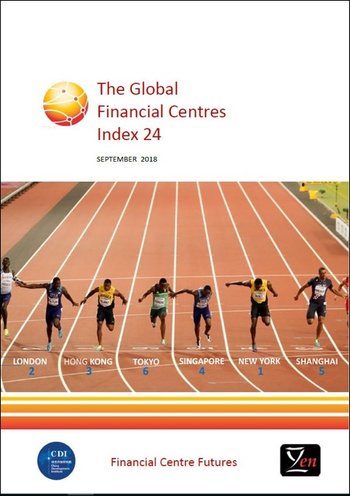
The Global Financial Centres Index 24 (GFCI 24)

Today Z/Yen Partners and the China Development Institute(CDI) publish the twenty-fourth Global Financial Centres Index (GFCI 24). The GFCI rates 100 financial centres. The main headlines are shown below:
Not for the first time, New York took first place in the index, just two points head of London. However both centres fell slightly in the ratings. Hong Kong is now only three points behind London. Shanghai overtook Tokyo to move into fifth place in the index gaining 25 points in the ratings. Beijing, Zurich, and Frankfurt moved into the top ten centres, replacing Toronto, Boston, and San Francisco.

In Western Europe, Zurich, Frankfurt, Amsterdam, Vienna, and Milan moved up the rankings significantly. These centres may be the main beneficiaries of the uncertainty caused by Brexit. Surprisingly, despite some evident success in attracting new business, Dublin, Munich, Hamburg, Copenhagen, and Stockholm fell in the rankings, reflecting respondents’ views of their future prospects.


The leading Asia/Pacific centres performed well, closing the gap on London and New York at the top of the rankings. Centres in the Asia/Pacific region generally rose in the ratings, continuing the trend which has been apparent over several years. There were steady increases for Shanghai, Sydney, Beijing, and Guangzhou. GIFT City (Gujarat) and Hangzhou entered the index for the first time.


North American centres fell back in the rankings and ratings overall. However, Los Angeles and Washington DC gained places in the index, with Washington DC reversing the fall it experienced in GFCI 23.


In Eastern Europe and Central Asia, there were significant gains for Astana, Budapest, St Petersburg, and Tallinn. Astana only officially launched their financial centre in July, and it is unusual for such a new centre to perform so strongly. The strong performance of Tallinn may reflect Estonia’s development of the e-society, including digital identity and smart ledger development, providing an alternative focus for Tallinn’s competitiveness. Cyprus and Warsaw fell significantly in the ratings and rankings. Sofia was a new entrant to the index.


The Middle Eastern centres Dubai, Abu Dhabi, and Doha all rose significantly reversing the trend from GFCI 23. Cape Town is the highest new entrant to the index, ranking 38th in its first entry.


There were mixed results in the Caribbean and Latin America. Bermuda, Sao Paulo, Mexico City, and Rio de Janeiro performed strongly, while other centres fell in the rankings.


Island centres fell in the index, with the exception of Bermuda, which rose six places. The British Crown dependencies of Jersey, Guernsey, and the Isle of Man all fell significantly in the rankings, with the Isle of Man dropping 27 places in the index.


Mark Yeandle, Director of Z/Yen and the author of the GFCI, said: "In GFCI 23 the leading centres all rose and the lower ranked centres fell. There is a much less clear pattern in GFCI 24. London and New York both few slightly, Asian centres did well and the North American centres fell back a little. Europe continues to interest us with potential beneficiaries of Brexit such as Frankfurt and Zurich doing well.”

Professor Michael Mainelli, Executive Chairman of Z/Yen, said: "Far too much attention is focused on the top centres and the blow-by-blow rankings they have. The long-term trend since our first published edition in 2007 has been the consistent and persistent rise of Asian centres while the press and pundits focus on brief headlines about London and New York City.”

11 September 2018

Former Executive of Loyal Bank Ltd Pleads Guilty to Conspiring to Defraud the United States by Failing to Comply with Foreign Account Tax Compliance Act (FATCA)

Earlier today in federal court in Brooklyn, Adrian Baron, the former Chief Business Officer and former Chief Executive Officer of Loyal Bank Ltd, an off-shore bank with offices in Budapest, Hungary and Saint Vincent and the Grenadines, pleaded guilty to conspiring to defraud the United States by failing to comply with the Foreign Account Tax Compliance Act (FATCA). Baron was extradited to the United States from Hungary in July 2018. The guilty plea was entered before United States District Judge Kiyo A. Matsumoto.

Richard P. Donoghue, United States Attorney for the Eastern District of New York; Richard E. Zuckerman, Principal Deputy Assistant Attorney General of the Justice Department’s Tax Division; William F. Sweeney, Jr., Assistant Director-in-Charge, Federal Bureau of Investigation, New York Field Office (FBI); and James D. Robnett, Special Agent-in-Charge, Internal Revenue Service Criminal Investigation, New York (IRS-CI), announced the guilty plea. Mr. Donoghue thanked the U.S. Securities and Exchange Commission (SEC), both the New York Regional Office and the Washington, D.C. Office; the City of London Police; the U.K.’s Financial Conduct Authority and the Hungarian National Bureau of Investigation for their significant cooperation and assistance during the investigation.                         

FATCA is a federal law enacted in 2010 that requires foreign financial institutions to identify their U.S. customers and report information (FATCA Information) about financial accounts held by U.S. taxpayers either directly or through a foreign entity. FATCA’s primary aim is to prevent U.S. taxpayers from using foreign accounts to facilitate the commission of federal tax offenses.               

According to court documents, in June 2017, an undercover agent met with Baron and explained that he was a U.S. citizen involved in stock manipulation schemes and was interested in opening multiple corporate bank accounts at Loyal Bank. The undercover agent informed Baron that he did not want to appear on any of the account opening documents for his bank accounts at Loyal Bank, even though he would be the true owner of the accounts. Baron responded that Loyal Bank could open such accounts and provide debit cards linked to them.

In July 2017, the undercover agent again met with Baron and described how his stock manipulation scheme operated, including the need to circumvent the IRS’s reporting requirements under FATCA. During the meeting, Baron stated that Loyal Bank would not submit a FATCA declaration to regulators unless the paperwork indicated “obvious” U.S. involvement. Subsequently, in July and August 2017, Loyal Bank opened multiple bank accounts for the undercover agent. At no time did Baron or Loyal Bank request or collect FATCA Information from the undercover agent. 

Baron’s guilty plea represents the first-ever conviction for failing to comply with FATCA. When sentenced, Baron faces a maximum of five years in prison.

Baron is the second defendant to plead guilty in this case. On July 26, 2018, Arvinsingh Canaye, formerly the General Manager of Beaufort Management Services Ltd. in Mauritius, pleaded guilty to conspiracy to commit money laundering. 

The case is being handled by the Office’s Business and Securities Fraud Section.  Assistant United States Attorneys Jacquelyn M. Kasulis, Michael T. Keilty and David Gopstein are in charge of the prosecution. The Criminal Division’s Office of International Affairs provided significant assistance in this matter.

10 September 2018

Thomas Wright, Gabriel Zucman : The Exorbitant Tax Privilege

We estimate and attempt to explain the evolution of the taxes paid by U.S. multinationals on their foreign profits since 1966. In the oil sector, taxes paid to oil-producing States have been contained, allowing U.S. firms to earn high after-tax returns. Foreign taxes fell abruptly after the first Gulf War. In sectors other than oil, the effective foreign tax rate has fallen by half since the late 1990s. Almost half of this decline owes to the rise of profit shifting to tax havens. The low foreign taxes paid by U.S. multinationals can explain half of the U.S. cross-border return differential.

FSC issues Public Notice - Surrender of the Representative of Investment Adviser (Unrestricted) Licence in the name of Ms. Itysha Sharona Ramdoss

PUBLIC NOTICE

Surrender of the Representative of Investment Adviser (Unrestricted) Licence in the name of Ms. Itysha Sharona Ramdoss

The Financial Services Commission, Mauritius (the “FSC Mauritius”) wishes to inform the public that ROGERS CAPITAL INVESTMENT ADVISORS LTD, having its registered address at No. 5, President John Kennedy Street, Port Louis has surrendered the Representative of Investment Adviser (Unrestricted) Licence in the name of Ms. Itysha Sharona Ramdoss in accordance with section 28 (5) of the Financial Services Act (the “FSA”).

Pursuant to Section 28(9) of the Financial Services Act 2007, the public is hereby notified that the Representative of Investment Adviser (Unrestricted) Licence in the name of Ms. Itysha Sharona Ramdoss stand terminated with effect from 27 August 2018.

You may contact the FSC Mauritius for any further information.

Financial Services Commission, Mauritius
7 September 2018

Mauritius: FSC issues Investor Alert against unauthorised entities

Public Notice

INVESTOR ALERT

All entities providing non-banking financial services in Mauritius must be licensed/ authorised /registered or approved (‘regulated’) (as may be appropriate) by the Financial Services Commission, Mauritius (the ‘FSC Mauritius’).

Statement

The FSC Mauritius alerts members of the Public and all other Stakeholders to the fact that there may be a number of entities engaged in financial services or financial services business activities as defined under the Financial Services Act 2007 (‘the FSA’) which are operating without being regulated under the relevant Acts.

The FSC Mauritius urges the Public/Stakeholders to exercise necessary caution prior to undertaking any financial services or financial business activities, and to deal only with persons/entities which are duly regulated by the FSC Mauritius under the relevant Acts. The FSC Mauritius cautions the Public/Stakeholders that there are numerous risks associated in dealing with unregulated entities. These may include losing money invested through fraudulent means.

The legal position

The FSC Mauritius is empowered, under section 6 of the FSA to, inter alia:

(a) license, regulate, monitor and supervise the conduct of business activities in the financial services sector and of global business;
(b) carry out investigations and take measures to suppress illegal, dishounorable and improper practices, market abuse and financial fraud in relation to any activity in the financial services and global business sectors; and
(c) take measures for the better protection of consumers of financial services.

All relevant entities wishing to engage or engaged in financial services shall apply for the appropriate licence(s)/authorisation/registration or approval for the conduct of their respective businesses.

Action

The Public/Stakeholders are invited to consult the Register of Licensees available on the FSC Mauritius website through the link,


before dealing with any entity. They may also wish to check for any investor alerts or any communiqués posted on FSC Mauritius website.

Stakeholders and the Public are also invited to contact the FSC Mauritius at
fscmauritius@intnet.mu or on + 230 403 7000, should they hold any material information/evidence that any person/entity may be infringing the relevant provisions of the FSA. All communication with the FSC Mauritius will be treated as strictly confidential.

Financial Services Commission, Mauritius
10 September 2018

08 September 2018

India: SEBI publishes interim report of Working Group on “KYC Requirements for FPIs” for public comments

In press release No.37/2018 dated September 5, 2018 it was, inter-alia, stated that the working group constituted under the Chairmanship of Shri H. R. Khan, Deputy Governor (Retired), Reserve Bank of India has held wide consultations with various stakeholders on the various issues raised in the representations made in relation to SEBI Circular No.CIR/IMD/FPIC/CIR/P/2018/64 dated April 10, 2018 on Know Your Client (KYC) Requirements for Foreign Portfolio Investors (FPIs) and is in the process of giving its recommendations. 

The working group has now submitted its interim report to SEBI. 

A copy of the report is placed on the website www.sebi.gov.in.  

Comments from public are invited on the recommendations contained in the aforesaid report.  

The comments may be submitted to kycforfpi@sebi.gov.in on or before 12:00 Noon on September 17, 2018.

07 September 2018

IFC Jurisdictions

The unique characteristics of international financial centres mean their economies have a heavy reliance on financial services, both for the sector’s contribution to local GDP and employment. This infographic explores the relationship between each jurisdiction's population size and financial industry, charting the wealthiest in terms of GDP per capita.

Moneyland: Why Thieves And Crooks Now Rule The World And How To Take It Back

From ruined towns on the edge of Siberia, to Bond-villain lairs in Knightsbridge and Manhattan, something has gone wrong with the workings of the world. 

Once upon a time, if an official stole money, there wasn't much he could do with it. He could buy himself a new car or build himself a nice house or give it to his friends and family, but that was about it. If he kept stealing, the money would just pile up in his house until he had no rooms left to put it in, or it was eaten by mice. 

And then some bankers in London had a bright idea. 

Join the investigative journalist Oliver Bullough on a journey into Moneyland - the secret country of the lawless, stateless superrich. 

Learn how the institutions of Europe and the United States have become money-laundering operations, undermining the foundations of Western stability. Discover the true cost of being open for business no matter how corrupt and dangerous the customer. Meet the kleptocrats. Meet their awful children. And find out how heroic activists around the world are fighting back. 

This is the story of wealth and power in the 21st century. It isn't too late to change it.

Guardian Review

Moneyland by Oliver Bullough review – the shadow world of the super-rich

The Long Read

The real Goldfinger: the London banker who broke the world

The true story of how the City of London invented offshore banking – and set the rich free

06 September 2018

Nespresso revives Zimbabwe’s coffee production

Nespresso announced today a long-term investment plan to revive Zimbabwe’s coffee industry and stimulate the rural economy.

The company will provide training and technical assistance to 400 smallholder coffee farmers over the next five years, with the goal of increasing the country’s production of quality sustainable coffee.

Zimbabwe’s coffee sector is in danger of disappearing as the result of a sharp decline in production over the past 18 years, following a series of economic shocks affecting many of Zimbabwe’s agricultural industries.

Nespresso expects to buy more than 95% of the high quality coffee production of Zimbabwean smallholders this season. The coffee will be available to global consumers in 2019. Nespresso is already working with farmers for the next harvest, where it expects volumes to increase, marking a potential turning point for Zimbabwe’s coffee producers.

“We are investing in reviving coffee farming in different regions of the world, where adverse conditions have impacted the lives of farmers and their ability to grow and nurture their coffee industries. Zimbabwe has a long history of producing beautiful coffees and we are pleased to be working with farmers through our AAA Sustainable Quality Program to help bring this industry back to life,” says Jean-Marc Duvoisin, CEO of Nespresso.

Together with TechnoServe, an international non-profit organization specializing in business solutions to poverty, Nespresso is training farmers to revive their production through climate-smart, sustainable farming practices.

“We are honoured to partner with Nespresso and the farmers of Zimbabwe to help transform one of the country’s most promising sectors and share more of its incredible coffee with the world,” said TechnoServe President and CEO William Warshauer.

“In line with TechnoServe’s market-centered approach to reducing poverty, we know that better coffee will lead to better incomes, better lives, and better futures for the hardworking people of Zimbabwe.”

The revival of the Zimbabwean coffee industry is part of Nespresso’s commitment to investing in coffee communities to create sustainable sources of income, preserve the environment and ensure coffee availability for future generations. Nespresso’s investment in Zimbabwe follows similar efforts the company has made to revive coffee production in South Sudan and in former conflict zones of Colombia.

About the AAA Sustainable Quality™ Program

Nespresso works with farmers through its AAA Sustainable Quality™ Program, which aims to create long-term, sustainable quality through direct relationships with farmers. Nespresso currently works with more than 75,000 farmers who benefit from hands-on support from agronomists as they learn how to develop their businesses. Working together, the agronomists and farmers look at the best growing and management practices for their crops, including technical assistance in agricultural practices to ensure quality. Through their participation in the AAA Program, the farmers are able to improve their coffee quality and achieve better productivity and standards in environmental and social welfare.

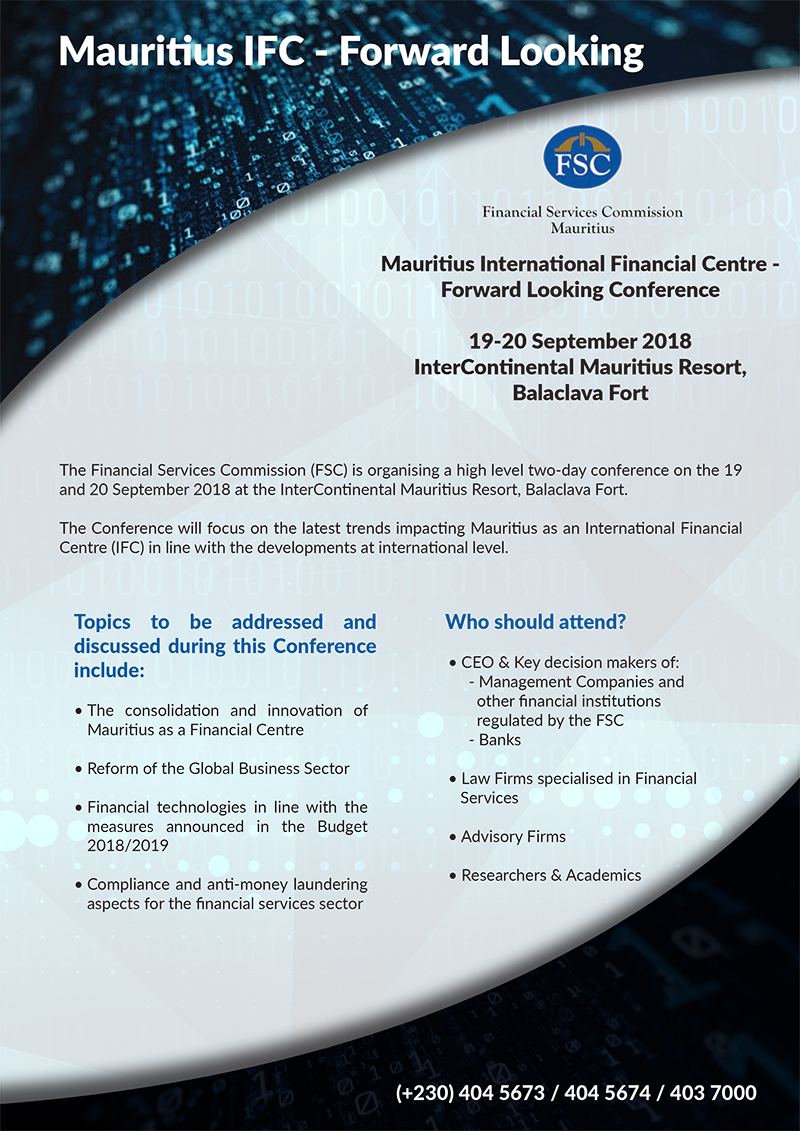
Mauritius International Financial Centre – Forward Looking Conference

The Financial Services Commission (FSC) is organising a high-level two-day conference on the 19 and 20 September 2018 at the InterContinental Mauritius Resort, Balaclava Fort.

The Conference will focus on the latest trends impacting Mauritius as an International Financial Centre (IFC) in line with the developments at international level.


05 September 2018

Raconteur: International Financial Centres 2018

From Guernsey to the Cayman Islands, offshore finance has long had a bad reputation. In recent years, however, far from being tax havens or hotbeds of dodgy dealings, these centres have become highly sophisticated and well regulated, rife with opportunities. The International Financial Centres report, published in The Times, explores how offshore funding is feeding into the UK’s smaller businesses, encouraging impact investing and offering exciting new roles for rising talent. Also covered is the effect new legislation is having on these unique centres.

Mauritius - Finance ​​InFocus: Newsletter September 2018 Issue 1​

The Ministry of Financial Services and Good Governance is pleased to introduce this first edition of its monthly newsletter. The launch of this newsletter is a major step for the Ministry to stay in touch with its different stakeholders, get their feedback and share concerns on issues of mutual interest. 

04 September 2018

Jersey Finance: The African FDI Opportunity

The commitment UK Prime Minister Theresa May made to invest £4bn into Africa during her visit to the continent last week should strike a chord with those familiar with Jersey’s international ambitions.

During her speech in South Africa, the UK PM highlighted that the UK would be making a "fundamental shift" in its strategic approach to Africa targeted aid, to focus more on long-term economic objectives.

The announcement came shortly after the Egyptian government had confirmed it was looking to increase its foreign direct investment by more than 40% to $11bn, with a view to creating 750,000 jobs, as part of a five year development plan. And just yesterday at the Forum on China-Africa Cooperation, China’s President Xi Jinping pledged £46bn in financing for projects in Africa as part of China’s efforts to link the continent’s economic prospects to its own.

The opportunities for Africa and its collective ambitions as a continent are clear, with the International Monetary Fund estimating that Africa could be a key performer this year. There are a number of very good reasons for this, not least the fact that growth in Africa is expected to accelerate to 3.5% this year, up from 2.9% in 2017, with nearly a third of African economies growing by around 5%. 

Meanwhile, leaders in Africa are increasingly serious about transparency and clamping down on corruption; Africa’s political landscape is liberalising; and the take-up of digital technologies by individuals and businesses across Africa is impressive.

There is clearly potential – but the flip side is that challenges still remain. As these latest commitments show, there is still a real need for foreign direct investment (FDI). It’s what we at Jersey Finance have been saying for years.

Back in 2015, we published an independent study that shed light on Jersey’s role in facilitating FDI around the world. It found that total global FDI by corporate investors stood at US$1.41 trillion in 2013, with such investment routed through IFCs at historically high levels, accounting for 6% of global FDI flows. 

It also found several African developing markets including Uganda, Mozambique, Egypt and Senegal benefit directly and indirectly from FDI originating from Jersey, to the tune of US$75.8 billion.

That report followed the publication in 2014 of the independent ‘Jersey’s Value to Africa’ paper. It found that Africa’s working age population is expected to double to 1.2 billion over the next 30 years and to support this, Africa will need to invest $85 trillion in infrastructure. 

At current levels of investment, it will fall $11.4 trillion short of that, with combined, aid, domestic profits and local governments able to plug less than half of this gap. The paper estimated that US$6.1 trillion would need to come from outside the continent through FDI with Jersey contributing between 0.5% and 1.5% of all foreign direct investment into the continent.

These finding still hold true - sourcing FDI into Africa is absolutely vital for Africa’s future. The commitments made by the UK and Egypt’s ambitions are absolutely a step in the right direction, but it is a small step in Africa’s journey and there is still much more that needs to be done. It is my prediction that high quality IFCs will need to play an increasingly important role in making sure that FDI reaches its intended destination and has maximum impact.

We feel strongly that Jersey has an important role to play in Africa’s future success, by providing a strong, robust, high quality platform to enable institutional investors to put their capital to work where it is most needed.

We took this message to London in the summer, at the Africa Financial Services Investment Conference (AFSIC) where we hosted a predominantly Jersey-based panel discussing the positive outlook of Jersey supporting African capital raising.

Earlier this year, we hosted a number of events in Nigeria, Kenya and South Africa, participated in the Africa Financial Services Investment Conference in London and took to the stage at the 4th Annual Private Equity in East Africa Conference in Nairobi to talk about how Jersey is supporting a growing number of African corporates and institutions looking to access global markets efficiently, safely and securely.

Later this year in October, we’ll be returning to South Africa to host two Roadshow events in Johannesburg and Cape Town to emphasise both our ability to support outbound African investment, but also to work with overseas investors to facilitate Africa-focused FDI and enable much-need capital to be put to work.

There’s no doubt that digital innovation, a burgeoning economically active population and global ambition have the potential to propel Africa to new heights – but that will need to be supported by considerable volumes of FDI, to support the necessary infrastructure investment that growth will require. The recent announcements from the UK and Egypt are acknowledgments of that. 

Centres like Jersey will need to play an increasingly vital role in enabling that to happen efficiently by providing the right expertise and regulatory framework to support high-quality inbound FDI to Africa.