22 June 2011

Financial Services in Emerging Economies 2011

UK banks account for 19% of lending to emerging economies, more than that provided by any other country.

Other key findings in TheCityUK's Financial Services in Emerging Economies 2011 report include:

• Most financial markets in emerging economies have risen faster than GDP between 2005 and 2010

• Fastest growing markets have been exchange-traded derivatives, bank assets, marine insurance, mutual funds and equity market capitalisation

• Financial market ranking for main emerging economies in line with ranking based on GDP

International bank lending, which has more than doubled over the past five years, is crucial for capital spending on infrastructure and other major projects. Lending by UK banks to emerging economies totalled $862bn at end-2010 and is particularly important to some countries accounting for 71% of lending to South Africa; 46% of lending to United Arab Emirates; 30% of lending to China, India and Malaysia; and 17% of lending to Brazil.

The CityUK report finds that growth in the largest emerging economies - led by Brazil, China and India - is being facilitated by rapid expansion of domestic and international financial markets in those countries: these markets increased by between 100% and 400% between 2005 and 2010, exceeding the 97% rise in nominal GDP in the same countries during this period.

In addition to international bank lending, those markets to have roughly doubled in size between 2005 and 2010 were domestic bonds and insurance. Markets to have risen more rapidly included commercial bank assets, marine insurance, mutual funds and equity market capitalisation which each rose about threefold. The number of contracts traded on derivatives exchanges grew fastest with a fivefold increase. Only pension assets and international bonds have grown more slowly than GDP: pension assets were up by a third and international bonds by over three quarters.

For many leading countries – including Brazil, China, India, Mexico, Turkey and Poland - their ranking amongst emerging economies based on GDP is similar to their ranking based on financial markets. For other countries there is some difference: for example, South Africa, Malaysia and Chile rank higher in the size of financial markets than on GDP ranking. By contrast, Russia, Indonesia and Saudi Arabia tend to have a lower ranking in financial markets than for GDP.


FSA: Banks’ management of high money-laundering risk situations

This report describes how banks operating in the UK are managing money-laundering risk in higher risk situations. It focuses in particular on correspondent banking relationships, wire transfer payments and high-risk customers including politically exposed persons (PEPs). PEPs are individuals whose prominent position in public life may make them vulnerable to corruption. The definition extends to immediate family members and known close associates.

21 June 2011

Tax Havens: Shady Deals

Clemens Fuest, July 2011

The World Today, Volume 67, Number 7

Strategic Reforms Crucial for Stolen Asset Recovery, Finds World Bank Study


Recent revolutions and uprisings in the Middle East and North Africa have raised questions about the capacity of financial centers to stop the flow of resources generated by  corruption. Barriers to Asset Recovery, released today by the World Bank Group  and the United Nations Office on Drugs and Crime’s (UNODC) Stolen Asset Recovery (StAR) Initiative, advises policy makers on reforms that will enable the recovery of stolen assets.

The study recommends eight strategic actions and other recommendations for policy makers, legislators and practitioners. They include the implementation of new policies and operational procedures to foster trust and mentor other jurisdictions, legislative reforms to facilitate freezing and confiscation of stolen assets, and better application of existing anti-money laundering measures.   

A complex process, asset recovery depends on  rapid international cooperation and often involves the exchange of  sensitive information. It also requires practitioners to be familiar with  legal  tools and procedures in their own country as well as partner countries.  

“There are many obstacles to asset recovery. Not only is it a specialized legal process filled with delays and uncertainty, but there are also language barriers and a lack of trust  when working with other countries,” said Kevin Stephenson, World Bank Senior Financial Sector Specialist and lead author of the study. “In  jurisdictions that do not prioritize these cases, practitioners do not develop the necessary expertise and agencies are not adequately resourced.”  

The authors consulted over 50  practitioners around the globe, who gave information based on their practical experience. The study analyzes the barriers to recovering stolen assets in foreign jurisdictions, and introduces examples of good practices. It also provides information about asset recovery regimes in various financial centers.

“This study is a powerful tool to help policy makers design a comprehensive strategy for stolen asset recovery, and implement the necessary reforms,” said Jean  Pesme,  Manager of the World Bank’s Financial Market Integrity Program and StAR Coordinator. “It can also aid practitioners by showing them how to use existing asset recovery tools more effectively.” 

20 June 2011

E&Y 2011 Worldwide Corporate Tax Guide

The Worldwide Corporate Tax Guide (WCTG) summarizes the corporate tax regimes in more than 150 countries. The content is based on information current on 1 January 2011, unless otherwise indicated in the text of the chapter.

Tax information

The chapters in the WCTG provide at-a-glance information, as well as details on the taxes on corporate income and gains, determination of trading income, other significant taxes, miscellaneous matters (including foreign-exchange controls, debt-to-equity rules, transfer pricing, controlled foreign companies and anti-avoidance legislation) and treaty withholding tax rates.

ICANN Approves Historic Change to Internet's Domain Name System

ICANN's Board of Directors has approved a plan to usher in one of the biggest changes ever to the Internet's Domain Name System. The Board vote was 13 approving, 1 opposed, and 2 abstaining.

During a special meeting, the Board approved a plan to dramatically increase the number of Internet domain name endings -- called generic top-level domains (gTLDs) -- from the current 22, which includes such familiar domains as .com, .org and .net.

"ICANN has opened the Internet's naming system to unleash the global human imagination. Today's decision respects the rights of groups to create new Top Level Domains in any language or script. We hope this allows the domain name system to better serve all of mankind," said Rod Beckstrom, President and Chief Executive Officer of ICANN.

New gTLDs will change the way people find information on the Internet and how businesses plan and structure their online presence. Internet address names will be able to end with almost any word in any language, offering organizations around the world the opportunity to market their brand, products, community or cause in new and innovative ways.

"Today's decision will usher in a new Internet age," said Peter Dengate Thrush, Chairman of ICANN's Board of Directors. "We have provided a platform for the next generation of creativity and inspiration."

The decision to proceed with the gTLD program follows many years of discussion, debate and deliberation with the Internet community, business groups and governments. The Applicant Guidebook, a rulebook explaining how to apply for a new gTLD, went through seven significant revisions to incorporate more than 1,000 comments from the public. Strong efforts were made to address the concerns of all interested parties, and to ensure that the security, stability and resiliency of the Internet are not compromised.

ICANN will soon begin a global campaign to tell the world about this dramatic change in Internet names and to raise awareness of the opportunities afforded by new gTLDs. Applications for new gTLDs will be accepted from 12 January 2012 to 12 April 2012.

PwC: Hedge fund infrastructure critical to addressing regulatory and business requirements

  • The crisis has been game changing for the way the sector will evolve, particularly in terms of infrastructure requirements
  • Having the right people, repeatable processes and scalable technology is more critical than ever
  • Growth and compliance benefits of investing in infrastructure will outweigh the costs
  • The sector’s talent needs are broadening; technology will enable transparency
Having the right people, processes and technology is fast becoming a prerequisite for hedge fund growth, according to a PwC paper published today. ‘Infrastructure: from cost to benefit – hedge funds 2.0’ examines the impact of the crisis on the industry and outlines what all parts of the hedge fund value chain need to do to satisfy regulatory demands and capitalise on growth opportunities.

Regulatory impetus includes the SEC registration requirements in the US (Dodd Frank), the Alternative Investment Fund Managers Directive (AIMFD) and the Foreign Account Tax Compliance Act (FATCA). These pressures, combined with greater investor due diligence and demands for transparency, are forcing hedge funds to change the way they operate.

Investors and regulators want to see reliable policies and controls in place across the hedge fund value chain. Areas of scrutiny include: valuation policies and procedures; safekeeping and controls surrounding funds’ assets; trading policies and procedures, including ethical guidelines; and compliance policies supporting multiple regulatory demands. Valuations are a particular concern for regulators in Europe and the US. PwC research* shows while most US alternatives funds have a valuation committee in place, there is a lack of consistency in materials and almost one third do not supply information to the boards of their offshore funds.

Mike Greenstein, global alternatives leader, PwC, said:

“Investors look for the ‘right’ kind of risk in their portfolios; they’re not looking to expose themselves to reputational or operational threats. Senior management want to insulate their organisations from damage to credibility and brand so things that may not have been the focus of a firm’s infrastructure a few years ago have become critical in the face of the double threat of investor activism and regulatory change.”

Beyond improving processes and formalising controls, hedge funds are finding that their talent needs are broadening while many technology platforms are not fit for purpose. For example, in the UK, 90% of asset managers categorise their compliance recruitment activity as active or very active.**

Mike Greenstein, global alternatives leader, PwC, said:

“The industry has always been resource constrained but we’re now seeing top performers with compliance, tax and valuation skills in ever greater demand. Those with credible risk, legal, finance and investor relations expertise are also highly sought after. In Europe, base salaries for experienced compliance staff have doubled in recent years as hedge funds compete for resources in a limited talent pool. Investing now and ring-fencing key talent will pay off.

“Technology platforms have often been developed on a piecemeal basis - pulling data from multiple systems is inefficient and not scalable. Addressing data requirements and the right technology infrastructure should be part of any firm’s future growth strategy.”

*PwC US 2010 Asset Management Valuation Survey

**PwC UK Asset Management Reward Survey

OCRA Worldwide Launches New Office in Dubai

OCRA Worldwide launches its 21st office in Dubai. OCRA Emirates LLC’s office in Dubai will be inaugurated on May 2nd, 2011 in Emaars’ Gold & Diamond Business Park, Office 224 (2nd floor), Building 5 on Sheikh Zayed Road.

OCRA Emirates LLC is a Joint Venture Company between Union International Holdings Group LLC, through its subsidiary Oryx Holdings LLC, and OCRA Worldwide. OCRA Worldwide is an International Company with over 35 years of experience and 20 offices all over the world, specializing in Corporate Services including setting up Offshore Companies, Offshore Banking, and Offshore Trusts.

“This is the first step for business activity for OCRA Worldwide in the Middle East and Gulf Consulate Countries. Other offices in the region will be launched at a later stage”, says Matt Sawaqed, CEO of Oryx Holdings LLC.

“OCRA Emirates will be able to service customers from its Dubai and Ras Al Khaimah offices to facilitate client services in a prompt and timely manner. Dubai is the financial centre of the Middle East and our commitment to the region to service our clients and their needs was an important strategic decision by the Group”, says Dharmesh Naik, Group Managing Director of OCRA Worldwide.

19 June 2011

Mauritius agrees to revise tax treaty

Mauritius has agreed to negotiate and revise the existing Double Taxation Avoidance Agreement (DTAA) with India and the two sides are expected to meet soon to work out the details, Central Board of Direct Taxes ( CBDT) chairman Prakash Chandra said here on Saturday. He said India has been seeking to tax capital gains on companies making profit in India.

17 June 2011

UK govt consults on reforms to the taxation of non-domiciled individuals & statutory definition of tax residence

The Government is today publishing a consultation on its plans to reform the taxation of non-domiciled individuals (“non-domiciles”). It wants to ensure that non-domiciles make a fair tax contribution, as well as encourage them to invest in the UK and simplify the current tax rules for them.

The consultation provides details on the package of reforms that were announced at Budget 2011 and will increase the tax charge for certain long-term resident non-domiciles to £50,000, provide a significant new incentive for non-domiciles to invest in the UK and simplify the rules to reduce administrative burdens. The Government does not intend to change the broad principles behind the existing tax system for non-domiciles.

The current rules discourage non-domiciles from bringing their income or capital gains to the UK, creating barriers to potential investment in the UK economy. The Government’s aim is to remove these barriers so that non-domiciles are encouraged to invest in UK business, contributing to its priority of generating growth and rebuilding the economy. However, a balance must be struck to ensure that they make a fair contribution.

David Gauke, Exchequer Secretary to the Treasury, said:

“The Government wants to ensure that the rules of our tax system are fair. That is why we are increasing the tax charge for those non-domiciles who have been resident in the UK for long periods of time. At the same time, it is important that skilled individuals and investors are encouraged to come to the UK from abroad and we recognise the fact that non-domiciles can make a valuable contribution to the UK economy. That is why we want to make it easier for them to invest in UK business.”

The Government is also today publishing a consultation on its plans for a statutory residence test (SRT). There is currently no full legal definition of tax residence, meaning that the rules are unclear, complicated and seen as subjective. This creates uncertainty for individuals about their residence status and is a deterrent to businesses and individuals considering investing in the UK. Today’s consultation proposes a framework for the SRT and seeks views on its design and implementation, in order to address these issues.

Both consultations published today close on 9 September 2011. A summary of responses to both will be published in the autumn. Draft legislation will be published for comment later in 2011 with a view to including final legislation in Finance Bill 2012.

Guernsey: GFSC Annual Report 2010

The GFSC Annual Report 2010 has been released. To view the document, please click the link below.

Annual Report 2010

16 June 2011

UK: Government publishes financial regulation White Paper and draft Bill

The Government has today published its financial regulation White Paper and draft Bill. These provide further detail on the Government’s proposed reforms to the financial regulatory regime within the UK.

Today’s White Paper has been extensively informed by the responses to the Government’s last round of consultation in February, and contains a number of new policy proposals which have been developed in light of stakeholder feedback, including:

  • a specific statutory objective governing the Prudential Regulation Authority’s responsibilities for the insurance sector;
  • an updated and enhanced competition regime under the Financial Conduct Authority (FCA); and
  • steps to strengthen the handling of cases of widespread consumer detriment, including misselling.

The publication of this White Paper marks an important stage in implementing these proposals as it sets out detailed policy plans alongside draft legislation to form a clear blueprint for reform. It also marks the beginning of the Parliamentary stages of the process: pre-legislative scrutiny of the draft Bill is due to begin shortly and, subject to the progress of pre-legislative scrutiny, the Government hopes to introduce the Bill later this year.

Launching the proposals, Financial Secretary to the Treasury Mark Hoban MP said:

"This is a key milestone in the process of developing and implementing a new system of financial regulation, which will address the flaws in the ‘tripartite’ model that contributed to the financial crisis. This is a detailed blueprint for regulatory reform setting out how the new structure will work. This Government is determined to strengthen the financial system and to do so in a way that gets it right - that’s why we’ve worked hard to consult with a wide-range of stakeholders over the last year. We look forward to working with stakeholders and Parliament during the period of pre-legislative scrutiny.”

Significant progress has been made since the Chancellor used last year’s Mansion House speech to outline the Government’s plans to fundamentally reform the UK’s failed system of financial regulation. The Government set out initial thinking last July, and a further consultation paper - with detailed proposals for establishing a new system of specialised and focused financial services regulators - followed in February 2011.

White Paper: A new approach to financial regulation: the blueprint for reform (PDF 4MB)

The fight against tax havens and tax evasion Progress since the London G20 summit and the challenges ahead

The recent crisis of 2008 has served to highlight the increasingly harmful effect of tax havens on the economy and on the social cohesion of developed and developing countries. The issue took on major importance at the G20 London Summit (April 2009), where the leaders announced a number of important steps to combat tax havens.

However, that initial drive has gradually lost momentum. The measures agreed at the time have proved incomplete, and in subsequent summits the G20 leaders have often limited themselves to expressing good intentions without taking concrete measures. It is to be expected that the next summit in Cannes (November 2011) will re-launch important aspects of the fight against harmful tax practices.

On the other hand, during the Spanish and Belgian presidencies of the EU in 2010, some important steps were taken towards a greater transparency in the international financial system and practices of multinational companies, which if fully implemented could have greater impact than the G20 measures.

This study seeks to take stock of progress achieved so far at the international level, particularly at the G20 and in the EU, and also to propose concrete measures for waging a more effective battle against one of the greatest scourges of our time: the dispossession of important resources from states and citizens for want of international coordination on taxation.

Mauritius Fostering a New Work Culture

Mauritius is trying hard to foster a new work culture which will take the country off the beaten track and if we really want to be a nation of dynamic entrepreneurs we should leave behind the past - a past that has entrenched the “business as usual” mode of operation and a mindset of rent seekers and speculators.

This is the gist of the message of the Prime Minister, Dr Navinchandra Ramgoolam, yesterday at the opening of the two-day Mauritius International Investment Forum (MIIF) 2011, at the Intercontinental Resort, Mauritius, in Balaclava.

Addressing some 600 local and international entrepreneurs, the Prime Minister said that whilst we are living in uncertain and volatile times, there can be potentially greater rewards and these rewards will go to those who can adapt to new rules and new ways of doing business.

Since 2005, said the Prime Minister, Mauritius has undertaken fundamental reforms of its policy in both domestic and private investments. We had to adapt because we could no longer rely on preferential access to markets. We shifted our paradigm and we have to set our economy on the path of global competitiveness, based on the principle that our country cannot always be tributary to the altruism of others, he added.

According to him, the expansion of the economic space through regional integration is an integral part of the country's development strategy and Mauritius is well positioned to act as a gateway between Africa and Asia. Commenting on the negotiations for a proposed Tripartite Free Trade Area (FTA) that would comprise member states of SADC, COMESA and EAC, Dr Ramgoolam underscored that the business community will have access to a huge market of more than half a billion people. He also appealed to the local and international entrepreneurs to use the MIIF platform to access the innumerable opportunities for investment in Africa. He also called upon the industries to focus on the BRICS countries while the global economy is rebalancing itself.

Dr Ramgoolam also announced that his office is already engaged in a vast audit exercise of parastatals and State owned enterprises. Lame Duck institutions that are frustrating the Government's efforts to meet the expectations of the nation will have to be phased out, he warned.

For his part, the Vice-Prime Minister, Minister of Finance and Economic Development, Mr Pravind Jugnauth, underlined that Government is promoting a major rebalancing of economic growth in Mauritius for two compelling reasons, firstly, to maximize the opportunities from the new multi-polarity of growth and secondly, to address the issue of vulnerability following the recent euro-crisis, so as to further improve the economic resilience.

According to Mr Jugnauth, an unprecedented era of opportunities is unfolding in Africa and several Mauritian enterprises in various industries are already taking advantage of these new opportunities. “We are looking forward for ways and means on how to improve trade, cross-border investments and other economic ties between Mauritius and India, China and other BRIC and newly emerging countries”, he added . Mr Jugnauth also lauded the positive ranking of Mauritius by the Overseas Development Institute (ODI) report “Mapping Progress” released recently and which places Mauritius as the Real Star Economy, in the league of high growth countries like Brazil, Thailand, Ghana, and Vietnam.

15 June 2011

Spread Trustee Company Limited v Sarah Ann Acato Hutcheson and others [2011] UKPC 13

On appeal from the decision of the Court of Appeal of Guernsey dated 26 November 2009

MEMBERS OF THE BOARD OF THE JUDICIAL COMMITTEE OF THE PRIVY COUNCIL: Lady Hale, Lord Mance, Lord Kerr, Lord Clarke, Sir Robin Auld

BACKGROUND TO THE APPEAL

This appeal concerns the law of trusts in Guernsey. The issue raised by the appeal is whether it was permissible for a trust deed to exclude a trustee’s liability for gross negligence prior to the entry into force of the Trusts (Amendment) (Guernsey) Law 1990 (‘the Amendment Law), which expressly prohibited such an exclusion.

The respondents, beneficiaries under two Guernsey trusts, brought a claim for damages for breaches of trust resulting from acts of gross negligence against the appellant trust company (“the trustee”). The trustee is said to have failed to identify and investigate breaches of trust occurring prior to 22 April 1989, when the Trusts (Guernsey) Law 1989 came into force and between 22 April 1989 and 10 July 1990, when the Trusts (Amendment) (Guernsey) Law 1990 came into force.

Each of the trust deeds contained a clause excluding the trustee from liability for any mistake or omission except wilful and individual fraud and wrongdoing. Whether or not a trustee could by contract exclude himself from liability for gross negligence as a matter of Guernsey law during the two periods was tried as a preliminary issue. Prior to 22 April 1989, this was a question of Guernsey customary law and between 22 April 1989 and 10 July 1990 it was a question of construction of the 1989 Law.

The respondents argued that it had never been possible to exclude a trustee’s liability for gross negligence as a matter of Guernsey law. They also argued that the 1989 Law and the Amendment Law have retrospective effect, with the result that the prohibition of clauses in settlements which exclude liability for gross negligence introduced by the Amendment Law is effective to defeat reliance upon the relevant clause in respect of all breaches of trust, whenever they occurred.

Section 18(1) of the 1989 Law provides that, “A trustee shall, in the exercise of his functions, observe the utmost good faith and act en bon père de famille”. Section 34(7) of the 1989 Law provides that, “Nothing in the terms of a trust shall relieve a trustee of liability for a breach of trust arising from his own fraud or wilful misconduct”. Subsection (7) was amended by the Amendment Law by the addition of “or gross negligence” at the end.

Lieutenant Bailiff Sir de Vic Carey held that it was not possible to exclude liability in respect of gross negligence either as a matter of Guernsey customary law or under the 1989 Law, which was declaratory of customary law. The Court of Appeal in Guernsey upheld the decision of the Lieutenant Bailiff. The trustee appealed to the Judicial Committee of the Privy Council.

JUDGMENT

The Board of the Judicial Committee of the Privy Council allows the appeal by a majority of 3:2. Lord Clarke gives the judgment of the Board. Lord Mance and Sir Robin Auld give additional concurring judgments. Lady Hale and Lord Kerr give dissenting judgments.

REASONS FOR THE JUDGMENT

The Board holds that liability of a trustee for gross negligence could lawfully be excluded as a matter of Guernsey customary law and under the 1989 Law.

•There is no case or text before 1989 which assists in answering the question what was the customary law of Guernsey in any relevant respect. In these circumstances, the Board considers the most valuable pointer to the correct answer to the question whether a term excluding gross negligence was contrary to Guernsey customary law before 1989 is the 1989 Law: [13], [83]. The fact that section 34(7) of that Law only forbids terms excluding gross negligence is good evidence that that was the position under Guernsey law before the 1989 Law: [24]. There is no reason to think that that subsection was not carefully considered and the 1990 Amendment Law, in adding the words “or gross negligence” cannot be regarded as recognition of a mistake by the 1989 draftsman, but rather as new law in line with the recent statutory change made in Jersey: [30]-[34], [119].

• Given that the 1989 Law would be most unlikely to have introduced a provision less favourable to beneficiaries than before, the Board does not agree with the Court of Appeal that it was not permissible for a trust to include a term excluding liability for gross negligence as a matter of Guernsey customary law: [34], [114]. Further, there is no reason to treat Guernsey law as following the Scottish view on this point in preference to the view taken under English law with which the Guernsey law of trusts is more closely associated: [40],[45], [109]. The underlying obligation to act en bon père de famille does not point to a conclusion that Guernsey would have adopted the Scots rule; the expression was French in origin and was not used in Scots law: [39], [122]. The Board finds that Armitage v Nurse [1998] Ch 241 correctly states what the law has always been in England, namely that liability for gross negligence can lawfully be excluded, and that it is much more likely than not that a Guernsey lawyer or judge or the Board itself, considering the position under English law before 1989, would have looked at the cases cited by Millet LJ in that case and reached the conclusion that he did: [57], [106].

Lady Hale and Lord Kerr dissent. They conclude that English law on the subject was not settled in 1988([130], [163]) and that the duty to act en bon père de famille is incompatible with the notion that a trustee could be exempted from gross negligence ([139], [145]). Lady Hale considers that in such circumstances there is no reason to disagree with the Guernsey courts’ conclusion as to how Guernsey law would have decided the matter then: [140]. Lord Kerr finds that in such circumstances it was entirely probable that the Guernsey court in 1988 would have been extremely reluctant to follow English law on this question: [168]. The dissenting Justices therefore would have held that it was possible to exclude liability for gross negligence as a matter of Guernsey customary law.

As to the question whether the 1989 Law and the Amendment Law have retrospective effect, the Board unanimously holds that there is nothing in the express terms of either Law that indicates an intention that the enactments were to have retrospective effect: [68], [72].

References in square brackets are to paragraph numbers in the judgment.

Rethinking Economics in a Changed World

Three Nobel laureates discuss what the crisis has taught us

Two and a half years after the collapse of Lehman Brothers triggered the worst global financial crisis since the 1930s, some of the biggest names in economics came together at the invitation of the IMF to discuss what we have learned—and what we need to do differently.

The crisis was a wake-up call for theorists and policymakers. Economic models and policy tools—and how they are used—must adapt to changes in the global economic and financial system.

“The crisis has clearly shown both the limits of markets and the limits of government intervention. It is time to take stock and draw a first set of lessons,” Olivier Blanchard, the IMF’s Chief Economist, told more than 300 academics, journalists, and civil society activists who recently gathered at IMF headquarters in Washington, D.C., for the conference.

F&D interviewed three Nobel laureates in economics who participated in the conference: Professor Michael Spence of Stanford University, Professor Joseph Stiglitz of Columbia University, and Robert Solow, professor emeritus at the Massachusetts Institute of Technology.

Jersey: Scheme to help graduates seeking employment is launched in conjunction with finance industry

Graduates seeking employment are invited to apply for an eight week scheme which will teach them key employment skills and offer work experience with a local finance company.

As part of the States of Jersey Fiscal Stimulus Package, the Advance Plus Employment Scheme was launched in September 2010 and the organisers have partnered with Jersey Finance, the finance industry’s promotional body, to help adults who have graduated from University to secure employment.

The Advance to Graduate Finance scheme is looking for 12 graduates to participate in the programme which will run from 4th July to 26 August 2011. Participants will learn personal development skills such as CV writing and interview skills along with an ‘Introduction to the Offshore Finance Industry’ at Highlands College. The scheme culminates in a four week placement with a local firm to give the graduates work experience. Entrants will go through a selection and interview process to secure a place on the scheme.

Rebecca Cook, Team Leader, Advance Plus, explained: ‘We are looking for 12 motivated and enthusiastic graduates, whether they have graduated this summer or in the past few years, who have not yet secured employment to join this voluntary scheme. We appreciate that it can be particularly hard for graduates to find employment when they return to the Island after University and this scheme will equip the graduates with a working knowledge of Jersey’s largest sector, the finance industry, and also teach them vital skills that employers look out for when recruiting.’

Geoff Cook, chief executive of Jersey Finance, commented: ‘The Advance to Graduate Finance Scheme offers graduates the opportunity to gain meaningful skills and work experience at a time when the employment market is recovering after the recession. The success of the scheme is reliant on finance firms offering placements and professional expertise and, with a number of placements still available, Jersey Finance members are encouraged to support the scheme. We anticipate that the programme will provide invaluable experience and help build graduates’ confidence when applying for long-term employment.’

Bankers on the Beach

Offshore Financial Centres (OFCs)—which specialize in supplying financial services to nonresident companies and individuals in exchange for low taxes, stability, and secrecy—are under scrutiny,whether they like it or not.

Host countries see such activities as a source of growth and a legitimate area for economic diversification. For critics, OFCs are a stark reflection of the severe problems—including tax evasion and money laundering—triggered by the lack of transparency and regulation that comes with unfettered globalization. For this reason, several international bodies, including the Financial Stability Board (FSB), the Financial Action Task Force (FATF), and the Global Forum/Organization for Economic Cooperation and Development (OECD), have launched or reinvigorated initiatives to strengthen the tax and financial regulatory policies under which OFCs operate.

Broad reach

Many OFCs attract large foreign financial flows, and OFCs’ financial sectors often exceed the size of their respective host economies. OFCs’ financial services operate through a variety of instruments, ranging from international banking and insurance to the structured investment vehicles that were at the center of the 2008–09 global economic and financial crisis (see Box 1; Lane and Milesi-Ferretti, 2010; and Hines, 2010).

Box 1. At your service

Offshore financial centers (OFCs) offer a menu of financial services.

International banking: Individuals and corporations in politically or economically unstable countries protect their assets by placing them overseas and avoiding scrutiny.

Headquarters services: For certain types of firms, there are legal and tax advantages to incorporating in an OFC. According to the U.S. Government Accountability Office (GAO, 2008), about 732 companies trading on U.S. stock exchanges, including Coca-Cola, Oracle, and Seagate Technology, reported to the U.S. Securities and Exchange Commission that they are incorporated in the Cayman Islands. Some firms opt to locate their head office in an OFC, with onshore activities being conducted by affiliates of the offshore headquarters.

Foreign direct investment: OFCs play an important role in the internal organization of multinational firms. For instance, the financial management and treasury operations of multinationals typically include offshore affiliates that support certain transactions, such as new acquisitions or mergers, or that permit foreign direct investment to be financed with debt rather than equity.

Structured finance: Before the 2008–09 economic crisis, many banks and hedge funds used OFCs for off-balance-sheet activities such as the so-called special purpose vehicles or structured investment vehicles. These vehicles were typically funded in onshore financial markets and purchased onshore assets.

Insurance: Commercial operations may establish an insurance company in an OFC to manage risk and minimize taxes, or onshore insurance companies may establish an offshore company to reinsure certain risks and reduce the onshore company's reserve and capital requirements.

Collective investment schemes: OFCs have participated in the hedge fund industry by housing feeder funds that gather clients' contributions, which are then managed by onshore master funds. In addition, leveraged feeder funds may borrow from offshore and onshore banks.


OFCs need to compete with onshore institutions. On the one hand, to attract business, they tend to offer low- or zero-taxation schemes that appeal to firms seeking to cut their tax bills. To some degree, this tax competition can facilitate better resource allocation. These efforts are sometimes supported by international tax treaties. On the other hand, OFCs are cost competitive, because they frequently operate under relatively weaker regulatory and supervisory financial standards—standards that are set by the host jurisdictions. This lax operational environment translates into lower administrative and operating costs but may not be fully consistent with international best practices.

Explicit secrecy rules and weak legal and administrative frameworks—which implicitly offer identity discretion to investors—have also attracted business from those seeking outright tax evasion and money laundering, raising strong concerns in the international community.

Counting for more

OFCs’ attractive financial and tax features have allowed them to capture a large and growing part of global financial flows. Indeed, 40 countries and territories hosting OFCs (Rose and Spiegel, 2007) held assets and liabilities of about $5 trillion at the end of 2009 (see Chart 1). To put this in perspective, cross-border assets and liabilities held by the United States, Germany, and France combined amounted to $8 trillion.

A place in the sun

While OFCs are present in most parts of the world, those located in the Caribbean region account for more than half of all OFC financial transactions. And within the Caribbean, the largest OFCs are located in nonsovereign territories—in particular, the Cayman Islands, a British overseas territory (see Chart 2).

Sticking to the rules

The significant financial flows handled by OFCs have long attracted attention to their activities. Because of this, the international community—through bodies such as the Global Forum/OECD, FSB, or FATF—has increased pressure on OFCs by launching initiatives to improve their adherence to international standards. Indeed, since the late 1980s, the international community has stressed that OFCs should follow increasingly strict prudential and supervisory financial standards, prevent money laundering, and limit opportunities for tax evasion and aggressive tax minimization schemes.

The 2008–09 global economic crisis renewed the debate on OFCs and the perception that they too must abide by the rules. As policymakers become increasingly aware that financial regulatory loopholes can undermine the stability of the global financial system, there has been a push to ensure that OFCs adhere to international standards. As in the case of onshore Ponzi schemes (for example, the Bernard Madoff scandal in 2008) in G-20 countries, there are also prominent examples of financial scams operated through OFCs (such as the Allen Stanford fraud, which led to the collapse of the Bank of Antigua in early 2009) raising awareness about the need to strengthen regulatory systems operating in OFCs. In addition, policymakers in advanced economies have been trying to address their growing fiscal challenges by closing legal loopholes that facilitate tax evasion, including a variety of mechanisms that rely on OFCs (see Box 2).

Box 2. Avoiding the tax man

A company can avoid taxes by establishing an offshoot in a low-tax jurisdiction such as an offshore financial center and having the entity engage in transactions with headquarters. This can shift corporate income—which is usually taxable—into the low-tax jurisdiction.

Tax evaders use tax havens in three ways:

Hiding income: receiving income in cash or another nontraceable form, and depositing it in an account in a tax haven (or having the payer deposit the money directly into an offshore account), without declaring the income in the home country;

Hiding investment income: depositing legal money in an offshore account but not declaring the interest or other investment income that is derived from it; and

Shifting taxable income: setting up a company in a tax haven and making payments to this company for nonexistent services or purchases whose price is exaggerated—known as aggressive transfer pricing—to shift taxable income to the tax haven.


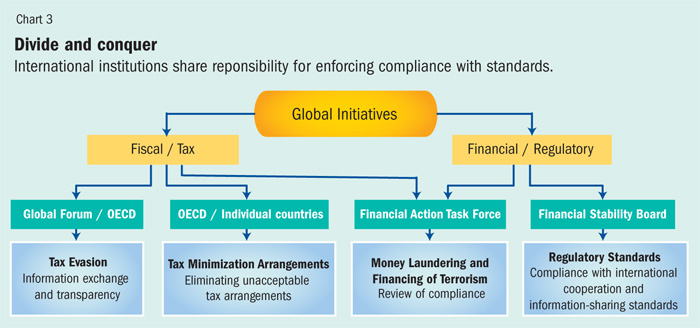
Current global initiatives on OFCs can be classified into four categories (see Chart 3):

Click to see full size image

reducing outright tax evasion, an initiative led by the Global Forum on Transparency and Exchange of Information and the OECD;

limiting legal tax avoidance, including a drive to establish global corporate tax policies led by individual advanced economies (G-20) and the OECD;

eliminating regulatory loopholes for financial institutions, which is spearheaded by the FSB; and

strengthening the fight against money laundering and financing of terrorism, led by the FATF with support from the IMF.

These four initiatives share many objectives—such as compliance with regulatory standards and transparency—but also have potentially adverse economic implications for OFCs. For example, reducing financial transactions could lower OFCs’ fiscal revenue, employment levels, and growth. This could happen for two main reasons. First, as OFCs update their regulations, they may become unable to offer secrecy arrangements or low-cost services. So changes that would have the unquestionable benefit of raising standards and reducing illegal activities performed through OFCs could also scare away some of their legitimate transactions. Second, a generalized “poor reputation effect” could spread across all OFCs, even those that are making efforts to comply with the international standards and attract legitimate business. The authorities in OFC-hosting jurisdictions are concerned that global action against the industry via mechanisms such as black/gray listings to reflect compliance with international standards (“naming and shaming” practices) or the application of sanctions could increase these risks.

Moreover, the intensified international push against the troublesome features of OFCs—while clearly critical to global financial and fiscal stability—has been gathering steam while some smaller jurisdictions hosting OFCs are still suffering from the 2008–09 financial crisis and facing a more challenging economic outlook. Indeed, because of a tepid recovery in OFCs’ key markets in Europe and the United States, tourism—an essential economic activity in most OFCs—has been lagging, and many countries that relied primarily on foreign visitors to fuel their economies are searching for new sources of growth. In this quest, OFCs continue to see the provision of offshore financial services as an important alternative for economic activity.

Fringe benefits

Higher capital inflows to OFCs can contribute to higher economic growth in the host jurisdiction as well as other benefits such as fiscal revenues and employment. Offshore institutions sometimes pay taxes and fees for activities such as registration and renewal operating license fees that can help sustain the public finances of their hosts, although this practice varies widely across hosting jurisdictions, which often forgo taxes and fees to attract OFCs. More important are the direct employment opportunities for local labor as well as spillovers to other sectors, including services such as tourism and infrastructure—OFCs often require upgrading of telecommunication and transportation.

Our research confirms that higher inflows to OFCs have a small positive impact on hosts’ economic growth (Gonzalez and others, forthcoming). These results hold whether or not the host is classified by the OECD as a tax haven.

Capital likes rules

High regulatory standards have a positive impact on capital inflows. There is some evidence that countries/jurisdictions that applied stronger regulatory standards (measured by the World Bank’s Worldwide Governance Indicators) benefited from higher portfolio investment flows in 2000–08. Thus, jurisdictions seeking to rely on offshore sectors as part of their development strategy are well advised to adopt strong regulatory standards. Being a tax haven alone does not guarantee capital flows; strong regulations that inspire confidence are a crucial factor.

Countries or territories that do not comply with international standards (particularly, those singled out by the OECD Global Forum on Transparency and Exchange of Information covering the availability, access, and exchange of information) were less successful in attracting flows during 2008–09. Initially, these standards required OFCs to sign a minimum of 12 bilateral tax agreements to exchange tax information. Evidence suggests that countries that were black- or gray-listed as part of the global initiative, for example, enjoyed a lower share of global total capital flows than those that were compliant, or white-listed (see Box 3). In other words, those OFCs that worked hardest to quickly align their regulations and laws with international standards benefited from their positive reputation.

Box 3. Black and white

To foster compliance with international tax standards, the Global Forum/OECD in 2009 used "naming and shaming"—classifying countries based on whether or not they were deemed to be complying with internationally agreed-on tax standards. If a country received a clean bill of health it was put on a white list. A country that had committed to the tax standards but had not yet implemented them found itself on a gray list. Countries that did not even commit to the standards ended up on a black list. Following the publication of the list, countries could move from the gray to the white list by signing at least 12 tax information and exchange agreements with other countries/jurisdictions. Both the FATF and the FSB might employ this approach in the future.


Many countries or territories hosting OFCs have moved forcefully to demonstrate their commitment to the international standards set by the ongoing global initiatives. For instance, while many of the Caribbean countries and territories were initially black- or gray-listed, all but one had by May 2011 signed the 12 tax information and exchange agreements required by the Global Forum/OECD to be moved to the white list. And OFCs are making efforts to increase compliance in other areas too.

OFCs might want to consider moving up the value chain by specializing in skills and regulation to retain or even increase flows—and hence their economic benefits. At the same time, jurisdictions with significant or expanding OFC activities should proactively ensure compliance with international standards. Because complying with increasingly higher standards is costly, countries and territories might want to evaluate the benefits and costs of providing OFC services. The smallest and most resource-constrained jurisdictions might want to take advantage of economies of scale and collaborate among themselves or create a regional body to provide accurate information about changing global standard requirements and technical assistance. ■